The Data Engine: How CPT 98977 Powers Your RTM Revenue

Decoding CPT 98977: The “Supply” Code Explained 

In the traditional therapy model, what happens at home stays at home. You hand out a paper exercise sheet, and you simply hope the patient does the work. 

Remote Therapeutic Monitoring (RTM) eliminates that guesswork, and CPT 98977 is the mechanism that pays you for it.

Think of CPT 98977 as the “subscription” code for your clinical device. It reimburses your practice for supplying the technology that tracks the patient’s musculoskeletal system.  

What CPT 98977 Actually Covers 

This code is distinct because it doesn’t pay for “time”—it pays for “data” and “technology.” Specifically, it covers the monthly supply of an FDA-cleared medical device (or software) used to monitor the musculoskeletal system. 

When you bill this, you are confirming three things occurred: 

  1. Device Supply: You provided a compliant device or software (SaMD). 
  1. Data Flow: The system automatically transmitted data (like range of motion or pain scores). 
  1. Scheduled Monitoring: This wasn’t a one-off check; it was continuous surveillance of the patient’s condition. 

Why CPT 98977 is a Game-Changer 

For years, the Home Exercise Program (HEP) was a “loss leader”—essential for recovery, but generated $0 in revenue. CPT 98977 flips this model. 

By implementing this code, you are effectively monetizing the time patients spend in rehab at home. It turns the “black box” of home recovery into a transparent, billable data stream. This encourages therapy adherence (because patients know you are watching) and provides a steady recurring revenue stream for the practice that scales with patient volume. 

The “Four Pillars” of Billing CPT 98977 

To secure reimbursement and survive an audit, you must hit these four non-negotiable requirements: 

  • The Device: It must be an FDA-cleared medical device. (A standard Fitbit or generic video app does not count). 
  • The System: It must monitor the Musculoskeletal System. 
  • The 16-Day Rule: The device must transmit data on at least 16 separate days within a 30-day period. 
  • The Plan: The monitoring must be integrated into a therapy plan of care. 

Reimbursement Expectations 

While exact rates fluctuate by region and Medicare Administrative Contractor (MAC), CPT 98977 is generally valued between $50 and $55 per 30-day episode. Since this code relies on software automation rather than direct clinician labor, it represents one of the highest-margin opportunities in the RTM code family. 

The 3 Biggest Challenges (And How to Solve Them) 

Implementing 98977 isn’t without friction. Here is where most practices fail, and how to avoid the traps. 

  1. The “Generic App” Trap (Selecting the Right Software)
    Many clinics make the mistake of using non-compliant wellness apps. Medicare is clear: the technology must meet the definition of a medical device.
  • The EMBODI Difference: You cannot bill for a PDF viewer. You need Software as a Medical Device (SaMD). EMBODI is one of the few platforms that is patented and FDA-cleared specifically for this purpose. Using our platform ensures you are meeting the strict regulatory definition required for payment. 
  1. The “Engagement Cliff”
    The hardest part of CPT 98977 is the 16-day requirement. If a patient gets bored and stops logging data on Day 14, you effectivelyworked for free. 
  • The Solution: Stop relying on willpower. Use a platform that “gamifies” the experience and provides automated feedback to the patient. If the tech isn’t engaging, the billing won’t happen. 
  1. Documentation Fatigue
    Manually counting how many days a patient logged in is an administrative nightmare.
  • The Solution: Your software should do the counting for you. Automated reporting is the only way to scale this without hiring more admin staff. 

Best Practices for High-Volume RTM 

  1. Use Audit-Ready Technology
    Don’t cobble together a solution. Choose a platform that automatically generates a timestamped log of every transmission. If an auditor asks, “Did this patient really engage for16 days?” your software should instantly produce the proof. 
  2. Automate the “Nudge”
    Your clinical teamdoesn’t have time to call every patient who misses a session. Set up automated push notifications within the app. A simple reminder at 6:00 PM can be the difference between hitting 15 days (unbillable) and 16 days (billable).

  3. Connect Data to Clinical Decisions
    Don’t just collect data for the sake of billing. Use the trend lines to adjust care. If CPT 98977 shows a drop in Range of Motion, bring the patient in sooner. This justifies the medical necessity of the device.

The Future of CPT 98977 

Right now, hitting that 16-day target is the only way to get paid for the supply code. But what about the patient who logs 10 days? 

Disclaimer: The information contained in this document does not, and is not intended to, constitute legal, billing, or regulatory advice or guidance. All information, content, and material is for general information purposes and independent review and/or counsel should be obtained before making any legal or billing decisions. 
 

CPT 98975 Explained: The Foundation of Remote Therapeutic Monitoring

CPT 98975: The Launchpad for Your RTM Program

Learn how to bill CPT 98975 for Remote Therapeutic Monitoring setup. We cover current requirements, reimbursement rates, and the new 2026 “Two-Day Rule.”

The Role of RTM

Remote Therapeutic Monitoring (RTM) is transforming how clinicians manage musculoskeletal and respiratory conditions. By extending the plan of care beyond the clinic walls, RTM allows providers to collect non-physiological patient data, such as therapy adherence, pain levels, and functional response between visits.

This continuous loop of data enables proactive intervention, higher accountability, and better clinical outcomes. For practices looking to implement this model, CPT 98975 is the critical first step.

However, the RTM landscape is shifting. As of January 1, 2026, reimbursement, billing thresholds, and code families will change in meaningful ways, creating both opportunities and complexities for healthcare organizations. Below, we break down what CPT 98975 covers today, what is changing in 2026, and how your practice can prepare.

What is CPT 98975?

Think of this as the “activation” code for a patient’s digital episode of care. It provides reimbursement for the professional time and resources required to: 

  • Set up the RTM device or FDA-cleared software application (like the EMBODI app). 
  • Pair the device with the patient’s profile. 
  • Educate the patient on how to use the equipment and log their data. 

Billing Frequency: This code can be billed once per episode of care. 

What’s changing in 2026—and how it affects CPT 98975 

For the past few years, there has been significant confusion regarding when this code becomes billable. Many organizations operated under the assumption that they had to wait for 16 days of monitoring to occur before they could bill for the initial setup, often leading to unbilled work if a patient dropped out early. 

The 2026 Update: The New “Two-Day” Standard


Beginning in 2026, the CPT codebook clarifies the minimum threshold. To bill CPT 98975, you must collect at least two days of RTM data within a 30-day period. 

This is a major win for scalability. By lowering the barrier to entry, CMS is confirming that RTM is not just for long-term chronic care—it is also viable for: 

  • Short-term rehabilitation. 
  • Post-surgical recovery. 
  • Transitional care episodes. 

Case Example: Post-Op Knee Recovery 

To see how this works in practice, consider a patient recovering from a Total Knee Arthroplasty (TKA). 


The Workflow:
 

  1. Day 0 (In Clinic): The Physical Therapist helps the patient download the EMBODI app, sets up their specific range-of-motion goals, and teaches them how to log their daily pain scores. 

  2. Day 1 & 2 (At Home): The patient goes home and logs their exercise adherence and pain levels for two consecutive days.


  3. The Result: Because the patient has successfully transmitted data for two days, the clinic has met the requirement to bill CPT 98975 immediately. They do not need to wait for the full month to pass to be reimbursed for the setup and education time. 

    Stay Tuned: The Full 2026 Playbook is Coming in January 

    While the “Two-Day Rule” simplifies activation, it introduces new tracking requirements. You need to know exactly when that second day of data hits your system to ensure timely billing. 

    Stay tuned for our complete “2026 RTM Code Guide,” launching in January. 

    How to Build a Patient Retention Flywheel for Your Chiropractic Practice

    The framework chiropractors use to grow through connection. NOT constant lead generation.

    What’s a Retention Flywheel?

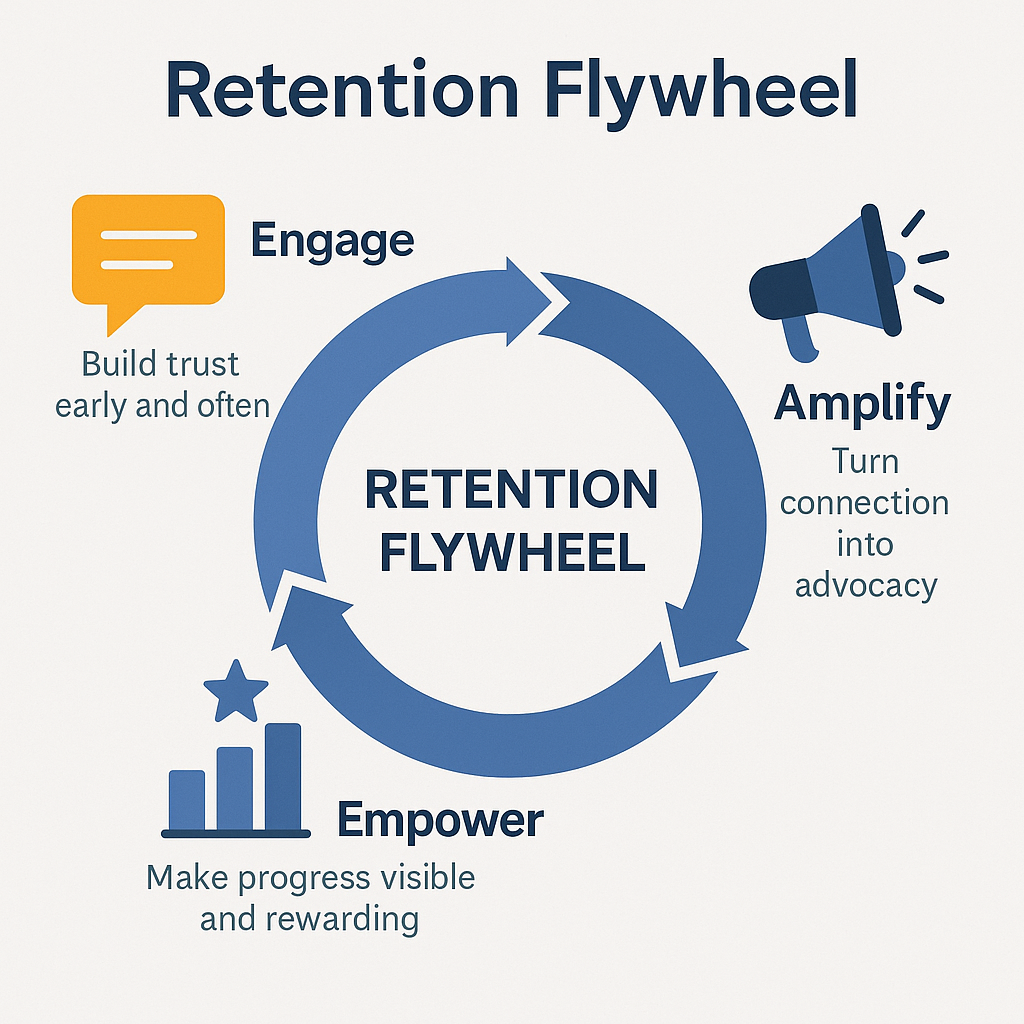
    A Retention Flywheel is a growth system where every patient interaction in person and between visits builds momentum.

    Instead of restarting from zero each month, your existing patients drive new growth through stronger engagement, better outcomes, and word-of-mouth referrals.

    This is how modern chiropractic practices scale sustainably, not by chasing more new leads, but by deepening relationships with the ones they already serve.

    In short: Connection compounds. Every message, milestone, and moment adds power to your practice.

    The Three Stages of a Patient Retention Flywheel

    Engage: Build trust early and often

    Engagement starts before the first adjustment. From that first text reminder to the post-visit message, every small, human touch builds trust.

    • Use SMS or email for logistics (reminders, reschedules, reactivations).

    • Use in-app messaging (via EMBODI) for clinical check-ins, secure, compliant, and personal.

    This dual-lane communication keeps your team efficient and your patients feeling seen.

    Goal: Make patients feel seen, supported, and accountable, from day one.

    Empower: Make progress visible and rewarding

    Patients don’t stay because you tell them to — they stay because they can see progress.

    That’s why gamification, visual tracking, and micro-wins matter.
    They transform “Am I getting better?” into “I am getting better.

    With EMBODI, clinics automatically track engagement, celebrate milestones, and send data-driven encouragement, all without adding admin work.

    Goal: Make patients feel seen, supported, and accountable, from day one.

    Amplify: Turn connection into advocacy

    When patients feel cared for, they become advocates.

    Each happy patient powers the next round of growth through referrals, reviews, and retention.

    Practical steps:

    • Ask for a review right after a win or milestone

    • Share success stories with consent

    • Celebrate your patients (email, lobby screen, social)

    Goal: Every happy patient becomes your best marketing channel.

    🔁 Why the Retention Flywheel Works

    A strong retention system is like compound interest for your practice.

    The more you invest in connection, the faster it grows.

    When each stage, engage, empower, amplify, feeds the next, you create self-sustaining growth instead of constant new-patient hustle.

    And this is where technology matters.

    Most “patient management” tools stop at reminders.

    EMBODI goes further; it keeps the relationship moving between visits.

    It’s one secure platform that helps you:
    ✅ Automate engagement (no manual follow-ups)
    ✅ Track patient progress and motivation
    ✅ Build lasting relationships that drive retention and referrals

    Across independent clinics using EMBODI:

    • 36% more visits kept

    • 40% more consistent revenue

    Same care. Different connection.

    Why EMBODI Stands Out

    Where other tools focus on admin efficiency, EMBODI focuses on engagement, the part that actually drives retention.

    It bridges both lanes of communication:

    • Clinical check-ins (in-app) HIPAA-compliant, trackable, and personalized.

    • Logistics (SMS/email) fast, friendly, and simple to automate.

    It’s not another system to manage; it’s the engine that keeps your Retention Flywheel spinning.

    🚀 Ready to Build Your Flywheel?

    Start small, one touchpoint per stage:

    • ENGAGE → Add a friendly “day-before” reminder.

    • EMPOWER → Send a progress check-in after week two.

    • AMPLIFY → Ask for feedback after each treatment milestone.

    Then watch momentum build, automatically!

    Want to see it in a live clinic?


    Book a zero-commitment Discovery Demo.

    See how EMBODI helps chiropractic teams turn everyday patients into raving fans.
    Because retention isn’t luck — it’s built.

    (Blog comments open below—share your toughest retention leak and we’ll reply with a tactical fix.)

    The Patient-Communication System That Quietly Lifts Retention

    Why Patient Communication Is the Growth Engine of Your Practice

    And why EMBODIconnect is the only system designed for retention, engagement, and compliance

    The Silent Profit Leak You’re Overlooking

    Most practices don’t lose patients because of poor care. They lose them because of poor communication.

    Here’s the reality:

    • Phone tag frustrates patients and burns staff time.

    • Late follow-ups miss the critical “post-visit 1–3” window when most drop-offs happen.

    • Vague reminders don’t drive adherence—or retention.

    The result? A silent leak of patients and revenue.

    That’s why we built EMBODIconnect: not another SMS tool, but a retention and engagement engine that closes the communication gap, keeps patients on track, and fills schedules without burning out staff.

    Clinic testimonial


    “When we switched to EMBODIconnect, everything improved. Patients started responding quickly and showing up consistently. Automations handle reminders and reactivations—hands-off. Even nights and weekends became productive because new patients book online at all hours. It’s transformed how we operate—I wouldn’t run our clinics without it.”


    Cat, Director of Operations (Kaizo Health Clinics)

    What Is EMBODIconnect?

    EMBODIconnect is a two-way patient communication engine—text, email, automation, and HIPAA-compliant in-app messaging—built inside EMBODI for MSK practices.

    It reduces no-shows, improves adherence, and even captures after-hours bookings, all while keeping communication clinical when it needs to be, and convenient when it doesn’t.

    Why This Matters (And Where Clinics Leak)

    A great care plan fails when communication fails. Patients don’t ghost because they don’t care—they ghost because they don’t feel connected.

    Typical leaks:

    • After visit 1–3, when soreness or fear sets in.

    • When pain improves and they think they’re “done.”

    • When staff can’t follow up consistently.

    The fix: A system that provides:

    • Right message, right time.

    • HIPAA compliance for clinical check-ins.

    • Convenience for everything else.

    How EMBODIconnect Works (Inside EMBODI)

    HIPAA-Compliant Clinical Messaging (EMBODI Core)

    Most platforms stop at SMS reminders. EMBODI goes further with secure, in-app messaging that keeps providers HIPAA compliant. You can run real clinical check-ins, review symptom updates, adjust plans, and even upload/share documents—without ever exposing your practice to risk.

    Two-Way SMS + Email (EMBODIconnect)

    For everything outside clinical messaging, EMBODIconnect powers two-way SMS and email. Reminders, reschedules, reactivations—all in one tap. It’s the convenience patients expect, without overloading your staff.

    Automated Reminders

    Standard workflows like visit reminders, day-after follow-ups, and 30/60/90-day reactivation pings—running automatically in the background.

    Smart Clinical Triggers

    Dynamic automations that respond to patient-reported outcomes. For example: if a patient reports soreness after an exercise, EMBODI can trigger a supportive check-in, flag the care team, or adjust the home exercise plan—closing the loop before issues become cancellations.

    After-Hours Lead Capture

    Custom forms plus auto-scheduling let new patients book themselves at night or on weekends. Your schedule fills while your staff rests.

    Dashboards That Matter

    One view, built for clinics: opens, replies, reschedules, kept visits, and adherence rates. Real-time data you can act on to improve both patient experience and clinic revenue.

    Templates You Can Use Today (paste into EMBODIconnect)

    Appointment reminder (Show-Up Saver)

    Hi [Name] — you’re on for [Day] at [Time].
    Reply Y to confirm or RESCHEDULE for a better time.

    Day-1 Check-In (catch problems early)

    How did [exercise] feel today?
    1 = Great, 2 = Tight, 3 = Need help.
    (If “3,” we’ll adjust your plan.)

    No-show rescue

    We missed you today and want you to feel better fast.
    Tap to grab the next spot: [link]. Need help? Just reply.

    Milestone celebration

    🎉 5-day streak, [Name]! Small wins stack.
    Next step: add 1 set to [exercise]. You’ve got this.

    Reactivation (30/60/90 days)

    Quick check-in on your [condition].
    Want a tune-up? Reply YES and we’ll text you times.

    Reviews & referrals

    Glad you’re feeling better, [Name].
    Would you share a quick Google review? It helps neighbors find care: [link]

    Implementation checklist

    • Two-way SMS verified (local area code)

    • Contact list synced and tagged.

    • 3 core workflows active (reminders, day-after, reactivation)

    • After-hours form connected to the calendar

    • Dashboard tile pinned: kept-visit rate week-over-week 

    What Success Looks Like (qualitative signals you’ll notice)

    • Fewer “Sorry I missed your call” loops

    • Faster replies to simple questions

    • Smoother rescheduling without staff back-and-forth

    • Patients referencing texts in the room (“I loved the quick video you sent”)

    • A calmer front desk and a steadier schedule

    The Takeaway

    Most tools promise reminders. EMBODIconnect delivers retention and engagement:

    • HIPAA-compliant clinical messaging (others can’t do this safely).

    • SMS/email convenience for patients (no friction).

    • Automation that runs in the background.

    • Dashboards that tie it all back to revenue and retention.

    It’s the only communication engine built specifically for MSK practices that protects providers, keeps patients engaged, and eliminates the silent profit leak.


    Want to see it in a live clinic?


    Book a zero-commitment Discovery Demo.

    We’ll walk through our exact EMBODIconnect workflows, timing, and message library—and answer any ops questions.

    (Blog comments open below—share your toughest retention leak and we’ll reply with a tactical fix.)

    FAQ


    Q: Why does texting beat calling for appointments?
    A: Texts are fast, low-friction, and asynchronous; one-tap replies reduce missed calls and phone tag.

    Q: Will automations feel impersonal?
    A: Not if you personalize variables ([Name], [Exercise], [Next Appointment]) and keep messages brief, helpful, and timely.

    Q: Can this support RTM?
    A: Yes. EMBODIconnect can prompt symptom check-ins, capture quick scales, and route flags to the care team, supporting RTM documentation and timely plan adjustments.

    Q: How soon should I send the first post-visit message?
    A: 24–36 hours after visit 1 is the sweet spot for catching soreness, confusion, or scheduling friction before it becomes a cancellation.

    RTM Uncovered: The Secret Weapon for Chiropractors to Boost Retention and Revenue

    Here is Your Wake-Up Call

    Ever looked at your appointment book and wondered why patients vanish after just a handful of visits? You’re giving the best adjustments, your front desk team’s friendly, your equipment’s cutting-edge—and yet, patients still drop off.

    We’ve been there. But then we made a critical shift: we introduced Remote Therapeutic Monitoring (RTM), and suddenly, our patients started sticking around. Better retention, better results, better revenue—without piling on extra hours.

    Here’s exactly how we did it.

    📌 What Exactly is Remote Therapeutic Monitoring (RTM)?

    In simple terms, RTM is your new best friend for keeping your patients engaged, accountable, and on-track outside your clinic.

    Instead of sending patients home with paper exercises that (let’s be honest) often end up forgotten, RTM digitally monitors their therapeutic activities, progress, pain levels, and adherence in real-time.

    By connecting with patients through an intuitive app, chiropractors can continuously track patient progress, proactively adjust care plans, and create an environment of accountability that’s proven to boost results.

    📌 The Big “Why”: Clinical Benefits of RTM

    RTM isn’t just tech for tech’s sake. It’s a clinical game changer.

    • Higher Adherence, Less Guesswork: RTM’s automated reminders and real-time feedback ensure patients stick to their care plans, drastically reducing missed exercises and therapy sessions.

    • Immediate Intervention: With instant data updates, you can catch setbacks before they become major issues. Immediate feedback means faster healing, fewer complications, and happier patients.

    • Personalized Adjustments: Gone are the days of standardized care. RTM allows you to fine-tune each patient’s therapeutic plan based on live data—making every patient feel like they’re your only patient.

    According to peer-reviewed research published in the Journal of Medical Internet Research, clinics implementing RTM see patient adherence jump by up to 70%, driving significantly better clinical outcomes.

    📌 How RTM Fuels Patient Retention (and Why That Matters)

    Patient retention is the lifeblood of your practice. The math is simple: keeping existing patients engaged is dramatically more cost-effective than constantly acquiring new ones.

    By adding RTM, practices consistently see:

    • Higher visit adherence rates (up to 40% improvement)

    • Increased patient satisfaction and perceived value of care

    • More consistent patient follow-through on care recommendations

    Bottom line? More visits, happier patients, and healthier practice revenues.

    📌 Turn Your Care into Cash: New Revenue Streams with RTM

    Let’s be clear: RTM is not charity work—it’s a smart, strategic revenue driver.

    RTM integrates smoothly with your billing, creating clear and sustainable income opportunities:

    • Monthly Monitoring Fees (CPT codes 98976/98977): Bill regularly for ongoing remote care and data tracking.

    • Treatment Management (CPT codes 98980/98981): Generate revenue from active management of patient adherence, communications, and care-plan adjustments.

    • Subscription-Based Wellness Plans: Offer premium care packages, bundling RTM with your HEPs and coaching services for consistent monthly income.

    📌 Getting Started: 5 Steps to Implementing RTM in Your Clinic

    Ready to embrace RTM but unsure how to begin? Here’s your practical, actionable guide:

    Step 1: Pick the Right Platform
    Start with a user-friendly, reliable app (like EMBODI) designed specifically for chiropractic and physical therapy practices.

    Step 2: Introduce RTM to Your Patients Early
    Mention RTM during the very first consultation. Demonstrate how it keeps them accountable and connected, enhancing their healing journey.

    Step 3: Automate Your Patient Engagement
    Use RTM to set up automated check-ins, personalized reminders, and friendly motivation boosts. The goal: fewer manual calls, more automated nurturing.

    Step 4: Track, Assess, Adjust
    Regularly monitor patient data and make quick care-plan adjustments. A few clicks can prevent patient dropout and keep outcomes on track.

    Step 5: Bill Consistently and Confidently
    Leverage your new RTM-generated data to ensure your billing reflects the quality and consistency of your care. You’re not just tracking activities—you’re proving your value.

    📌 The RTM Edge: Why Smart Chiropractors are Already Onboard

    Early adopters of RTM aren’t just tech enthusiasts—they’re strategic thinkers. They understand that patient retention, satisfaction, and practice growth don’t happen by chance. They’re outcomes driven by consistent, high-quality engagement and care.

    EMBODI clinics using RTM and gamification see measurable improvement:

    • 70% higher patient adherence rates

    • Increased patient engagement and referrals

    • Substantial revenue boosts through billable services

    This isn’t a tech trend—it’s a proven strategy.

    🚀 Ready to Make RTM Your New Revenue Engine?

    There’s no reason your practice should miss out on this advantage. If you’re ready to shift from guesswork to guaranteed results, let’s talk.

    Book a zero-commitment Discovery Demo today and we’ll show you exactly how RTM integrates seamlessly into your practice workflow.

    👉 [Book Your Discovery Demo]