Peer-reviewed results published in the Journal of Contemporary Chiropractic: how structured patient engagement between visits keeps patients in care.
The Problem Every Chiro Knows
You sign up a patient for a care plan. Life gets busy, pain decreases, they forget to book their next appointment, and without something keeping them accountable between visits, the care plan dies.
Research has a name for it: self-discharge. The patient walks away from care before the plan is complete—no discharge from you, no clinical resolution, just an appointment that never gets booked. It's the quiet leak in almost every practice's retention and revenue.
So we studied it—and published the results.
What Changes With EMBODI
EMBODI does one specific thing: it keeps patients engaged between visits. It's not replacing your care. It's supporting the patient's commitment to the care plan through check-ins, progress tracking, and accountability.
In a peer-reviewed study published in the Journal of Contemporary Chiropractic (2026), analyzing real billing data from a multi-location chiropractic practice (n = 2,378), the findings were clear:
Prescribed visits kept: 35% more among EMBODI users (P < .001)
Self-discharges: 8.9% fewer among EMBODI users (P = .03)
Even when patients did leave early: EMBODI users who self-discharged still generated 52.9% more revenue before leaving (P < .001)
This isn't theory, and it isn't marketing math. This is actual billing data, analyzed with a sample of 2,378, reviewed by independent peers, and published in a scientific journal.
35%
More prescribed visits kept
P < .001
8.9%
Fewer self-discharges
P = .03
52.9%
More revenue from patients who self-discharged
P < .001
The Questions Smart Chiropractors Ask
Objection: "These are just naturally compliant patients."
Fair question—patients who opt into an engagement platform are demonstrating some motivation up front. This is observational data, so patient self-selection can't be fully separated from product impact. What the study shows: the differences held across a sample of 2,378 at statistically significant levels on all three findings, and the methodology and its limitations went through independent peer review. We'd rather show you honest observational data than a polished claim.
Objection: "This is just one practice."
True—it's a single multi-location practice. But it's real billing records across multiple clinic locations, not surveys or projections, and the analysis was rigorous enough to pass peer review. It's some of the strongest real-world evidence available on engagement and retention in chiropractic. And you don't have to take our word for it: the full paper is published and citable.
Objection: "Vendor research is just marketing."
That's exactly why we submitted it to a journal instead of a slide deck. The study—Topp R, Greenstein J, Etnoyer-Slaski J—was independently peer reviewed and published in the Journal of Contemporary Chiropractic (2026;9(1):92-101). Every number on this page comes from that publication.
What This Means For Your Practice
The mechanism is simple: EMBODI keeps patients connected to their care plan between visits. Check-ins, progress tracking, accountability. Patients who engage this way keep more of their recommended visits—not because they're forced to, but because they're supported in following through on their own commitment.
Patients using EMBODI kept 35% more of their prescribed visits and were significantly less likely to walk away from care before completing it.
And here's the part most practices miss: even the patients who eventually left care early generated 52.9% more revenue when they were on EMBODI—because engagement kept them in care longer before they left. The retention lever pays off at every stage of the patient journey, not just for the patients who finish.
But the real win isn't the revenue. It's having patients actually show up for the care you prescribed—the thing every clinical result downstream depends on. The revenue follows naturally when your retention improves.
The Honest Summary
What the data shows: EMBODI users kept 35% more prescribed visits, self-discharged 8.9% less often, and generated 52.9% more revenue even when they did self-discharge.
What's verified: All three findings are statistically significant and published in a peer-reviewed journal.
What we can't claim: Causation—this is observational data—or that every patient will see these exact results.
What matters: The retention lever works. When you give patients a system for staying accountable between visits, they stay.
Research Credibility
These results come from a peer-reviewed study of real, de-identified billing records (n = 2,378) at a multi-location chiropractic practice, published in the Journal of Contemporary Chiropractic in 2026. Not surveys, not estimates, not projections.
Topp R, Greenstein J, Etnoyer-Slaski J. Journal of Contemporary Chiropractic. 2026;9(1):92-101. n = 2,378.
About EMBODI Health
EMBODI is a Remote Therapeutic Monitoring platform built specifically for musculoskeletal care. It combines patient engagement workflows with clinical monitoring and RTM billing, all inside your EHR or as a standalone app. It's used in chiropractic, physical therapy, and other MSK settings. Learn more at www.embodihealth.com.
What's Your Retention Gap?
A 20-minute audit shows you exactly where you're losing patients—and what closing that gap means for your revenue.
EMBODI Health Just Evolved Industry's Only Behavioral Science-Powered Gamification Platform for Chiropractic Patient Retention
Clinical data shows gamified engagement closes $54K annual revenue gap while increasing patient visits by 55%
Washington, DC — May 26, 2026 — EMBODI Health today announced the launch of its proprietary SynapticAI™-powered gamification platform—the first and only behavioral science-driven patient engagement system designed specifically for chiropractic practices. Clinical validation across 4,188 patients demonstrates that gamified engagement drives 67% more revenue per patient and reduces first-visit dropout rates from 16% to 3%.
The platform addresses what EMBODI founder Dr. Jay Greenstein calls "the $54,000 problem"—the measurable revenue gap between practices that engage patients through behavioral infrastructure versus those relying on traditional compliance methods.
"Your patients will spend 40 minutes playing Candy Crush but struggle with 4 minutes of exercises that will actually heal them. That's not a motivation problem. It's a neurological infrastructure problem. We're the only company in chiropractic that's solved it."
Dr. Jay Greenstein — Founder & CEO, EMBODI Health
The $54K Revenue Gap
Clinical data from a 16-month study of 1,781 patients at the OM Center revealed the financial impact of patient engagement infrastructure. 984 EMBODI patients generated $970,000 in revenue. Meanwhile, 1,453 non-EMBODI patients generated $917,000—a $54,000 gap despite having 469 more patients.
Per-patient analysis showed EMBODI patients averaged 11 visits and generated $1,400 in revenue per patient, with only a 3% one-and-done dropout rate. Non-EMBODI patients averaged 7 visits, generated $840 in revenue per patient, and had a 16% one-and-done rate.
"The data is unambiguous," said Dr. Greenstein. "Patients who engage with EMBODI complete substantially more of their plan of care and generate meaningfully more revenue for the clinic. The product works through retention, not pricing."
Why This Happens: The Dopamine Gap
Traditional patient engagement relies on reminders, motivation, and better instructions—none of which close what behavioral scientists call "the dopamine gap." When patients complete home exercises, they receive no immediate feedback, no progress visualization, no evidence that today's effort connects to tomorrow's outcome. The brain interprets this silence as: this doesn't matter.
That's the dopamine gap—and it's why 60-70% of patients quit their home exercise programs before they finish their plan of care.
The Only Platform Built on Behavioral Science
EMBODI is the only patient engagement platform in chiropractic using real-time behavioral reinforcement powered by proprietary AI:
SynapticAI™ Behavioral Engine: Proprietary AI continuously analyzes patient engagement patterns and dynamically personalizes motivational touchpoints based on what's actually working for each patient.
Real-time feedback loops: Streak tracking, progress visualization, and achievement systems trigger the same dopamine response as mobile games.
Proactive intervention: Platform flags at-risk patients before they become the 16% who never return after visit one.
Automated documentation: Pre-populated RTM billing data enabling $78-106/month in recurring revenue per engaged patient.
"There are plenty of apps that send reminders or show exercise videos," said Dr. Greenstein. "We're the only platform that closes the dopamine gap with infrastructure that makes compliance the path of least resistance."
Three Revenue Streams Most Practices Miss
When patients actually complete their care plans, three things happen:
RETENTION Revenue: Patients who finish their programs don't drop off after visit 3. They come back for the full 11-visit average. That's 4 additional visits at $130/visit = $520 more per patient who stays engaged.
ENGAGEMENT Revenue: Engaged patients create new billing opportunities. If they're using the app 20+ minutes per month and you're tracking their exercises, that's RTM-billable activity. CPT codes 98975, 98977, 98980, 98981 done right = $78-106/month in recurring revenue per engaged patient.
REWARDS Revenue: Patients who complete care plans refer more often, return for maintenance, and buy into cash services. These aren't included in the visit averages above—but they compound.
"Practices don't need more new patients," said Dr. Greenstein. "They need infrastructure that helps current patients finish what they started. That's where the money is."
Clinical Validation Across Seven Practices
EMBODI's outcome data is grounded in peer-reviewed research and real-world practice analytics. Published studies in the Journal of Medical Internet Research (JMIR, 2021 and 2023) established the behavioral science and gamification models underlying the platform.
40.48% improvement in patient retention rates
36.12% increase in practice revenue
Significantly higher home exercise program completion rates
Across seven practices totaling 4,188 patients, EMBODI demonstrated statistically significant improvements in patient retention and revenue attributed to engagement-driven care. These results position EMBODI as one of the most clinically validated RTM platforms in the chiropractic market.
The Market Opportunity
The reimbursable RTM market is projected to exceed $2.4 billion by 2028, driven by CMS reimbursement expansion and rising demand for clinic-based care. Chiropractic represents one of the fastest-growing segments, yet fewer than 5% of practices are currently utilizing RTM billing codes—representing hundreds of millions of dollars in unrealized reimbursement annually.
EMBODI is positioned to capture significant market share as the only behavioral science-powered platform with clinical validation across thousands of patients.
About EMBODI Health
EMBODI Health is a Remote Therapeutic Monitoring (RTM) company that uses behavioral science, proprietary SynapticAI™ technology, and evidence-based gamification to improve patient adherence and clinical outcomes in musculoskeletal care. Founded by Dr. Jay Greenstein—a 32-year chiropractic veteran, multi-practice owner, and recognized healthcare innovation leader—EMBODI has validated its platform across 4,188 patients in seven practices. The company is headquartered in Washington, DC. Learn more at www.embodihealth.com.
Chiropractic Patient Retention: How Gamification Drives 67% More Revenue Per Patient
Your chiropractic patients will spend 40 minutes playing Candy Crush but struggle with 4 minutes of exercises that will actually heal them.
That's not a motivation problem. It's an infrastructure problem.
And it's costing your chiropractic practice real money in lost patient retention.
The Patient Retention Problem Costing Chiropractors $54K Per Year
Here's what most chiropractors don't realize: patient engagement isn't a "nice-to-have" feature that makes your practice feel modern. It's the single biggest lever you have for revenue growth—and most chiropractic practices aren't pulling it.
We recently analyzed 16 months of patient retention data from a busy chiropractic practice. The results weren't subtle.
Patients who used EMBODI's gamified patient engagement platform:
• Averaged 11 visits per episode (vs 7 visits for non-users)
• Generated $1,400 in revenue per patient (vs $840 for non-users)
• Had a 3% one-and-done rate (vs 16% for non-users)
That's 55% more visits. 67% more chiropractic revenue per patient. And 13 percentage points fewer patients who disappear after the first visit.
But here's the part that stopped us cold: Over 16 months, 984 EMBODI patients generated $970K in revenue. Meanwhile, 1,453 non-EMBODI patients—that's 469 MORE patients—generated only $917K.
Read that again.
Fewer patients. More revenue. By $54,000.
The difference? One group had infrastructure that turned patient compliance into the default. The other group relied on willpower and PDF handouts.
Why Patients Quit Home Exercise Programs: The Dopamine Gap
Your chiropractic patients aren't lazy. They're human.
When someone plays Candy Crush, every action produces immediate feedback. Match three candies → satisfying sound → points flash → dopamine hit. The brain gets what it needs: evidence that the behavior matters.
When they do home exercises? Silence.
No streak counter. No progress bar. No evidence that today's effort connects to tomorrow's outcome. The brain interprets this as: this doesn't matter.
That's the dopamine gap—and it's why 60-70% of your patients quit their home exercise programs before they finish their plan of care.
Why Traditional Patient Engagement Strategies Fail
Most chiropractors try to solve low patient compliance with:
More motivation ("you've got to stick with it!")
Better reminders (automated texts saying "don't forget your exercises!")
Clearer instructions (video demonstrations of each movement)
None of these close the dopamine gap.
Motivation assumes the problem is willpower. It's not. The brain needs feedback loops, not pep talks.
Reminders tell patients what to do but don't tell them why it matters. You're adding friction, not removing it.
Better instructions optimize the wrong variable. Patients already know how to do the exercises. They stop because there's no reinforcement when they do them.
The patient engagement problem isn't educational. It's neurological.
Behavioral Science-Powered Gamification: The Solution to Low Compliance
Gamification isn't about making exercises "fun" with cartoonish graphics and badges. It's about building infrastructure that makes patient compliance the path of least resistance.
At EMBODI, we use SynapticAI™—a proprietary behavioral engine that analyzes patient engagement patterns in real time and dynamically adjusts motivational touchpoints based on what's actually working for each patient.
Here's what that looks like in practice:
Patient Experience: Real-Time Feedback Loops
Streaks: Complete 3 days in a row? The app celebrates it. Miss a day? It doesn't guilt-trip you—it offers a micro-commitment to get back on track.
Progress visualization: Every completed exercise moves the progress bar. Every session adds to the weekly total. The brain sees: this is working.
Achievements unlocked: Hit milestones (10 sessions, 50 exercises, 30-day streak) and the app recognizes it. Not with fake trophies—with evidence that you're doing the work.
Provider Benefits: Automated Tracking and Documentation
Real-time dashboard: See which patients are engaged, which are slipping, and which need a nudge—before they ghost you.
Automated documentation: All the patient engagement data you need for RTM billing, pre-populated and ready to submit.
Proactive intervention: The platform flags at-risk patients so you can reach out before they become the 16% who never come back.
This isn't theory. This is what drives significantly higher compliance rates compared to traditional patient engagement methods.
Three Chiropractic Revenue Streams Most Practices Miss
When patients actually complete their care plans, three things happen:
1. Patient Retention Revenue (11 vs 7 Visits)
Patients who finish their programs don't drop off after visit 3. They come back for the full 11-visit average. That's 4 additional visits you're not currently capturing.
At $130/visit, that's $520 more per patient who stays engaged.
2. Engagement Revenue (RTM Billing Opportunities)
Engaged patients create new billing opportunities. If they're using the app 20+ minutes per month and you're tracking their exercises, that's RTM-billable activity.
Patients who complete care plans refer more often, return for maintenance, and buy into cash services (massage, supplements, wellness plans). These aren't included in the visit averages above—but they compound.
I used to think I needed more new patients. Turns out I just needed my current patients to actually complete their programs.
Case Study: $54K Revenue Gap Between Engaged and Non-Engaged Patients
We've run this analysis across multiple chiropractic practices now. The pattern holds.
From the OM Center study alone: 984 EMBODI patients generated $970K in revenue over 16 months. Meanwhile, 1,453 non-EMBODI patients generated $917K—a $54,000 gap despite having 469 more patients.
This gap comes from:
Fewer one-and-done patients (the 13-point gap between 3% and 16%)
More visits per patient (the 4-visit difference between 11 and 7)
Higher lifetime value (engaged patients refer, return, and upgrade)
You're not leaving money on the table because you're bad at chiropractic. You're leaving it there because you don't have infrastructure that makes patient follow-through the default.
What Makes EMBODI's Patient Engagement Platform Different
There are plenty of patient engagement apps out there. Here's why ours actually moves chiropractic revenue:
1. We're the ONLY platform using behavioral science-powered gamification
Most apps send reminders or show videos. We close the dopamine gap with real-time feedback loops, streak mechanics, and progress visualization based on how the brain actually works.
2. Our AI adapts to each patient
SynapticAI™ doesn't treat every patient the same. It learns which motivational strategies work for each person and adjusts dynamically. Some patients respond to streaks. Others respond to achievement unlocks. The platform figures it out.
3. We integrate with ChiroTouch
As of February 2026, EMBODI is natively integrated with ChiroTouch EHR. That means one-click enrollment at the point of care, automated documentation, and real-time dashboards—all without leaving your workflow.
4. We've validated this across 4,188 patients
The 40.48% improvement in patient retention and 36.12% increase in practice revenue aren't projections. They're measured outcomes across seven chiropractic practices and 4,188 patients.
Clinical Validation: 4,188 Patients Across Seven Practices
Not all of the revenue lift is "the platform." Some of it is patient selection.
Patients who choose to onboard to EMBODI are more motivated to begin with. They're the kind of people who take an extra step toward their recovery.
But here's what matters for your chiropractic practice:
The platform identifies those patients early. You know who's likely to complete care on day one, which lets you focus your energy where it'll have the most impact.
The platform amplifies their follow-through. Motivated patients still drop off if there's no infrastructure. EMBODI keeps them on track.
Even when we control for motivation by comparing only highly-engaged patients in both groups (5+ visits), EMBODI patients still complete more of their care plan.
So yes, selection plays a role. But the platform works.
How ChiroTouch Users Can Improve Patient Retention Starting Today
If you're a ChiroTouch user, you now have access to the same behavioral infrastructure that generated these patient retention results.
Here's what changes:
Week 1: Patients enroll at the point of care. They start tracking exercises immediately.
Week 2-4: You see real-time patient engagement data. You know who's sticking with it and who needs a nudge.
Month 2-3: Patient retention rates start climbing. The "one-and-done" problem shrinks. Visits per patient tick up.
Month 6: You're billing RTM consistently. Your average revenue per patient is measurably higher. Patients are referring more often because they're actually seeing results.
This isn't a "nice-to-have" upgrade for chiropractic practices. It's the infrastructure that makes the difference between 7-visit patients and 11-visit patients. Between $840 per patient and $1,400 per patient. Between business-as-usual and closing a six-figure revenue gap.
See How Much Revenue Your Practice Is Leaving on the Table
We're doing Strategic Revenue Audits for ChiroTouch users this week.
In 30 minutes, my team will show you:
Your current visits per patient vs what's possible with better patient retention
Where your patient engagement drops off
What all three revenue streams look like in your chiropractic practice
Frequently Asked Questions About Chiropractic Patient Retention
What is the average patient retention rate in chiropractic?
Most chiropractic practices see patients complete 7 visits on average, with 16% of patients never returning after their first visit (one-and-done rate). Practices using behavioral science-powered engagement see 11 visits on average with only a 3% one-and-done rate.
How can chiropractors improve patient compliance with home exercise programs?
Traditional methods (reminders, motivation, better instructions) have limited impact. Evidence shows that gamification with real-time feedback loops, streak tracking, and progress visualization significantly improves compliance by addressing the neurological need for immediate reinforcement.
What is the ROI of patient engagement technology for chiropractic practices?
Clinical data from 1,781 patients shows engaged patients generate 67% more revenue ($1,400 vs $840 per patient) and complete 55% more visits (11 vs 7 visits). One study showed 984 engaged patients generated $54,000 more revenue than 1,453 non-engaged patients over 16 months.
Does EMBODI integrate with ChiroTouch?
Yes, as of February 2026, EMBODI is natively integrated with ChiroTouch EHR, providing one-click patient enrollment, automated documentation, and real-time engagement dashboards directly within the ChiroTouch workflow.
About EMBODI Health: EMBODI is the patient engagement flywheel for chiropractic practices. We help patients stay consistent with their care plans through behavioral science, SynapticAI™, and evidence-based gamification. Better adherence leads to more completed visits, stronger outcomes, cleaner documentation, and new revenue opportunities.
Founded by Dr. Jay Greenstein, a 32-year chiropractic veteran, multi-practice owner, and healthcare innovation leader, EMBODI gives clinics the infrastructure to turn patient follow-through into measurable growth. Book an EMBODI demo.
Gamification: The Secret to Patient Retention (And More Revenue) | EMBODI
How to increase HEP compliance from 40% to 85%+ using behavioral science—and why it unlocks all three revenue streams
JG
Dr. Jay Greenstein
Founder & CEO, EMBODI | 2026 UAC Top 20 Most Influential Nominee
Here's a question most chiropractors avoid asking: What percentage of your patients actually complete their home exercise programs?
If you're honest, the answer is somewhere between 30-50%. Industry research consistently shows that fewer than half of patients follow through with prescribed HEPs.
And here's the brutal math: every patient who quits their HEP early is revenue you'll never capture.
Not just the lost office visits. The entire value of that patient relationship—RTM billing, referrals, cash services, lifetime value—evaporates when they disengage.
Gamification fixes this. And the impact goes far beyond compliance rates.
The $6,200 Problem Most Chiropractors Don't See
Let's start with what you're actually losing when patients quit their HEPs early.
Average chiropractic patient completes 8-12 visits when engaged, versus 3-5 visits when they drop off after initial pain relief. That's a 5-7 visit difference per patient.
At $75/visit average, that's $375-525 in lost visit revenue per patient.
But that's only one revenue stream. When a patient disengages, you also lose:
RTM revenue: Can't bill for remote monitoring if they're not using the app (~$85/month × 6 months = $510)
Referrals: Disengaged patients don't refer friends (~1.5 referrals lost per patient)
Cash services: No upsells or add-ons when they're not coming in
Add it up: $6,000-8,000 in total lost value per disengaged patient.
For a practice that loses 20 patients to poor compliance per month? That's $120K-160K annually walking out the door.
The Engagement Gap (Stats)
30-50%
Average HEP compliance (industry standard)
70-85% HEP compliance with gamification
+2.5 Additional visits per engaged patient
Why Traditional HEPs Fail: The Psychology
Before we talk about the solution, we need to understand why patients quit their home exercises in the first place.
It's not laziness. It's neuroscience.
The Dopamine Problem
Human brains are wired to seek immediate feedback and reward. Every action we take triggers a question: "Did that work?"
When the answer is unclear or delayed, our brains lose motivation. This is the dopamine gap—the space between action and reward where engagement dies.
Traditional HEPs live entirely in this gap:
Patient does exercises at home
No immediate feedback on form or completion
No visible progress tracking
No acknowledgment until next office visit (days or weeks later)
No sense of achievement or milestone
From a behavioral psychology perspective, this is the worst possible design for habit formation.
The Habit Loop
Charles Duhigg, "The Power of Habit":
Cue → Trigger the behavior
Routine → Perform the action
Reward → Get positive reinforcement
Traditional HEPs have a clear Cue (pain, doctor's orders) and Routine (exercises), but the Reward is absent or severely delayed. Without immediate positive reinforcement, the habit never forms.
The Feedback Vacuum
Even when patients want to do their exercises, they face practical barriers:
Uncertainty: "Am I doing this correctly?"
Invisibility: "Is this actually helping?"
Isolation: "Nobody knows if I skip today"
Monotony: "This is the same thing every day"
These aren't character flaws. They're predictable psychological responses to poor system design.
How Gamification Solves the Dopamine Gap
Gamification applies game design principles to non-game contexts. In the context of HEPs, it means redesigning the experience to trigger the brain's reward systems.
Here's how it works:
1. Immediate Feedback
Every exercise completion triggers instant visual feedback:
Points awarded
Progress bar advances
Streak counter increments
Daily goal fills in
This closes the dopamine gap. Action → Immediate Reward.
2. Progress Visualization
Patients see their progress in real-time through:
Completion percentages
Weekly consistency graphs
Improvement trends
Before/after comparisons
The brain loves progress. Even small visible gains trigger motivation to continue.
3. Variable Rewards
Not all rewards should be predictable. Behavioral psychology research shows that variable rewards (unpredictable positive outcomes) create stronger engagement than fixed rewards.
Examples:
Bonus points for completing exercises at optimal times
Surprise milestones ("You just hit 50 total exercises!")
Unlocked achievements for consistency
Random encouragement messages from your chiropractor
This is the same mechanism that makes slot machines addictive—applied to health outcomes.
4. Social Proof and Accountability
Humans are social creatures. We're motivated by:
What others are doing (social proof)
Who's watching us (accountability)
Recognition from authority figures (praise from doctors)
Gamified HEPs leverage this through:
Leaderboards (optional, for competitive patients)
Visible progress shared with chiropractor
Peer comparison (anonymized)
Public milestones and achievements
"The most powerful behavior change happens when people feel like they're part of something, making progress, and being seen. Gamification creates all three."
— BJ Fogg, Stanford Behavior Design Lab
The Data: What Gamification Actually Achieves
Theory is nice. Let's look at what actually happens when you gamify HEPs.
Compliance Rates
Method
Compliance Rate
Average Completion Duration
Paper handouts
30-40%
2-3 weeks before dropout
Basic app (no gamification)
50-60%
4-6 weeks before dropout
Gamified app
70-85%
12+ weeks sustained engagement
That's not a marginal improvement. That's a fundamental shift in patient behavior.
Visit Frequency
Engaged patients complete more of their prescribed care plan:
Traditional HEP patients: 6.2 visits average
Gamified HEP patients: 8.7 visits average
Difference: +2.5 visits per patient
At 100 new patients per month, that's 250 additional visits monthly, or 3,000 visits annually.
At $75/visit: $225,000 in additional visit revenue.
And that's just the Retention stream.
The Flywheel Effect: How Gamification Unlocks All Three Revenue Streams
Here's where it gets interesting. Gamification doesn't just improve one metric. It creates a compounding effect across all three revenue streams.
Let's break down the mechanism:
REWARDS → Drives Initial Engagement
Gamified HEPs use rewards to hook patients:
Points for completing exercises
Badges for hitting milestones
Streaks for daily consistency
Unlockable achievements
Patients open the app more frequently. They complete more exercises. They stay engaged longer.
Result: Higher initial engagement rate (70-85% vs 30-50%)
ENGAGEMENT → Drives Retention
Engaged patients complete their care plans:
They show up to appointments
They finish their prescribed visit series
They continue care after pain resolves
They become long-term wellness patients
Result: +2.5 visits per patient average
RETENTION → Unlocks RTM Billing
Patients who consistently use gamified HEPs generate RTM billable time:
You review their exercise completion data
You respond to their progress updates
You adjust their care plans based on adherence
You message them about milestones or setbacks
Every interaction is documented, timestamped, and billable.
Result: $85-95/patient/month in RTM revenue (vs $0 for disengaged patients)
RTM + RETENTION → Drives More Rewards
Patients who complete their programs and see results become your best marketing:
They refer friends and family
They leave positive reviews
They upsell themselves on cash services
They become lifetime patients
Result: 1.5-2x referral rate vs disengaged patients
Traditional Model: Acquire patient → Treat pain → Patient drops off → Acquire new patient → Repeat
Flywheel Model: Engage patient → Complete care plan → Generate multiple revenue streams → Patient refers others → Exponential growth
What Gamified HEPs Look Like in Practice
Let's get concrete. What does this actually look like for a patient?
Day 1: Onboarding
Patient downloads app, sees their personalized exercise program with video demonstrations. First completion awards 50 points and a "Getting Started" badge.
Dopamine hit: Immediate.
Week 1: Habit Formation
Daily reminders at optimal times. Each completion adds to their streak counter. They see progress: "4 days in a row!" Visual progress bar shows completion percentage.
Chiropractor receives notification: "Sarah completed all exercises 5/7 days this week." Sends encouraging message: "Great work this week!"
Dopamine hit: Daily + social recognition.
Week 2: Milestone
Patient hits 50 total exercises. Unlocks "Consistency Champion" achievement. App shows: "You're in the top 25% of patients for engagement!"
Dopamine hit: Achievement unlocked + social proof.
Week 4: Progress Review
In-office visit. Chiropractor pulls up their engagement data: "You've completed 85% of prescribed exercises. This is why you're seeing such great improvement."
Patient sees direct correlation between effort and outcome.
Dopamine hit: Validation + outcome confirmation.
Month 3: Long-term Engagement
Patient has 90-day streak. Refers a friend (gets "Community Builder" badge). Continues exercises even after pain resolves because the habit is formed.
Result: Lifetime patient created.
The ROI of Gamification
Let's do the math for a practice with 100 active patients.
Without Gamification
40% HEP compliance
40 engaged patients × 6.2 visits = 248 visits
60 disengaged patients × 3.5 visits = 210 visits
Total: 458 visits
Visit revenue: 458 × $75 = $34,350
RTM revenue: $0 (can't bill disengaged patients)
Referrals: Minimal
Annual: ~$412,000
With Gamification
75% HEP compliance
75 engaged patients × 8.7 visits = 653 visits
25 disengaged patients × 3.5 visits = 88 visits
Total: 741 visits
Visit revenue: 741 × $75 = $55,575
RTM revenue: 75 patients × $90/mo × 12 = $81,000
Referrals: 75 × 1.5 × $400 = $45,000
Annual: ~$550,000+
$138K+
Additional annual revenue with gamification
For work you're already doing. The only difference is how patients engage with their HEPs.
See the Flywheel in Action
EMBODI's gamification engine drives 70-85% HEP compliance, unlocking all three revenue streams. See how behavioral science turns patient engagement into predictable revenue.
Traditional chiropractic practices focus on patient acquisition. They're refilling a leaky bucket.
The Flywheel focuses on patient engagement. It fixes the leak first, then scales.
The question isn't whether gamification works. The behavioral science is clear.
The question is: How much longer can you afford to leave $138,000+ per year on the table?
Ready to Fix the Leak?
See how EMBODI's gamification engine increases HEP compliance from 40% to 85%+ and unlocks all three revenue streams. Schedule a 15-minute demo to see the Flywheel in action.
Dr. Jay Greenstein is the Founder & CEO of EMBODI and a 2026 nominee for UAC's Top 20 Most Influential People in Chiropractic. After watching thousands of patients quit their HEPs early, he created EMBODI to apply behavioral science principles to patient engagement—turning compliance rates from 40% to 85%+ and unlocking the Flywheel effect.
The Complete Guide to RTM Billing for Chiropractors (2026) | EMBODI
How to capture ~$85+ per patient/month in recurring revenue for work you're already doing
JG
Dr. Jay Greenstein
Founder & CEO, EMBODI | 2026 UAC Top 20 Most Influential Nominee
1. What is RTM (Remote Therapeutic Monitoring)?
Remote Therapeutic Monitoring (RTM) is a set of CPT codes that allow healthcare providers to bill for non-physiologic patient monitoring and treatment management services delivered remotely.
In plain English: You can bill for the time you spend managing patients between office visits.
If you're:
Texting patients about their home exercise compliance
Reviewing their progress data remotely
Adjusting care plans based on their feedback
Monitoring adherence through apps or systems
Responding to patient questions about their treatment
You're doing RTM work. The question is: are you billing for it?
RTM vs. RPM: What's the Difference?
RPM (Remote Physiologic Monitoring) tracks physiologic data like blood pressure, glucose, weight, heart rate.
RTM (Remote Therapeutic Monitoring) tracks non-physiologic data like:
Exercise completion and adherence
Musculoskeletal symptoms
Range of motion progress
Pain levels
Functional improvement
Therapy compliance
For chiropractors, RTM is the relevant code set because you're monitoring therapeutic activities (home exercises, stretches, rehab protocols), not vital signs.
2. Why RTM is Perfect for Chiropractic Care
Chiropractic care extends well beyond the adjustment table. Effective treatment requires:
Patient education on home exercises
Ongoing compliance monitoring
Progress tracking between visits
Care plan adjustments based on patient feedback
Communication about setbacks or improvements
You're already doing this work. RTM simply allows you to get paid for it.
The Revenue Opportunity
$51K-57K
Annual RTM revenue for 100-patient practice (2026 rates)
Conservative estimate for a practice with 100 active patients:
40-50% qualify for RTM (patients with ongoing therapeutic programs)
Average reimbursement: ~$85-95 per patient/month (2026 actual rates)
Monthly RTM revenue: $4,250 - $4,750
Annual RTM revenue: $51,000 - $57,000
For work you're already doing.
But RTM Doesn't Exist in Isolation
RTM is ONE of THREE revenue streams every patient creates. Most chiropractors only capture one.
When combined with:
RETENTION: Gamified HEPs that patients actually complete (+2.5 visits/patient)
REWARDS: Systematic referrals and cash service purchases
The total revenue impact is 3-4x higher.
That's the Flywheel.
3. The Three RTM CPT Codes Explained (2026 Actual Rates)
RTM billing uses three CPT codes. Here's what each one covers with 2026 actual reimbursement rates:
CPT 98975
Initial Setup & Patient Education
What it is: Initial setup and patient education on using the monitoring system (20 minutes minimum).
When to bill: Once per patient when you educate them on how to use the system, what to track, and how to report progress.
2026 Rate: $21.71
Example
You spend 20 minutes showing the patient how to record their exercises, track symptoms, and message you through the app. Bill 98975.
CPT 98977↑ 29% Higher Than Expected
Device Supply & Monitoring (16-30 days)
What it is: Supply of therapeutic monitoring device or application with data transmission (16-30 days).
When to bill:Monthly for each patient actively using the monitoring system.
2026 Rate: $51.44
Key Update: This code jumped to $51.44 in 2026 (expected $39.75) — 29% higher than projected! This makes RTM significantly more profitable than previous estimates.
CPT 98980
Treatment Management Services (20+ minutes)
What it is: Monthly treatment management, including monitoring patient data and adjusting the care plan (20 minutes minimum per calendar month).
When to bill:Every month for each patient who meets the time threshold.
2026 Rate: $54.11
Example
Throughout the month, you:
Review patient exercise completion data (5 minutes)
Respond to patient messages about pain levels (4 minutes)
Not every patient qualifies for RTM. Here are the criteria:
Qualifying Conditions
Patients must have a musculoskeletal condition requiring therapeutic monitoring, such as:
Chronic low back pain
Neck pain and cervical dysfunction
Post-injury rehabilitation
Posture correction programs
Chronic joint conditions
Neurological rehabilitation
Sports injury recovery
Any condition requiring ongoing therapeutic exercise
Qualifying Activities
The patient must be engaged in therapeutic activities you're monitoring:
Home exercise programs (HEPs)
Stretching protocols
Postural correction exercises
Functional movement training
Pain management techniques
Rehabilitation protocols
Patient Consent
Patients must:
Consent to RTM monitoring
Agree to use the monitoring system/app
Understand the service is billable
Get written consent before starting RTM billing.
5. The 16-Minute Threshold (What Actually Counts)
Here's where most chiropractors get confused.
To bill CPT 98980 each month, you must spend at least 20 minutes of interactive time managing that patient remotely.
What Counts Toward the 20 Minutes
✅ Activities that count:
Reviewing patient-reported exercise completion data
Analyzing progress reports and adherence metrics
Responding to patient messages about symptoms or concerns
Adjusting care plans based on remote feedback
Reviewing video submissions of exercises
Educating patients on technique modifications
Following up on missed exercises or setbacks
Documenting all of the above
❌ Activities that DON'T count:
Time spent during in-office visits (that's billed separately)
Automated system notifications (no human interaction)
Scheduling appointments
Billing and administrative tasks
General practice management
Real-World Examples
Example 1: Patient texts about increased pain
Read message and review recent exercise data: 3 minutes
Respond with care plan adjustment: 2 minutes
Document interaction: 1 minute
Total: 6 minutes
Example 2: Weekly progress review
Check adherence dashboard for 5 patients: 8 minutes
Message 2 patients who are behind: 4 minutes
Document reviews: 3 minutes
Total: 15 minutes across multiple patients
Example 3: Patient video review
Watch patient's exercise video submission: 2 minutes
Identify form issues: 1 minute
Send corrective feedback: 3 minutes
Document: 1 minute
Total: 7 minutes
Tracking Time Efficiently: The challenge is tracking these micro-interactions across dozens of patients. Most chiropractors spend well over 20 minutes per patient per month on remote monitoring — they're just not documenting it.
6. Documentation Requirements
Proper RTM billing requires documentation that proves:
The service was medically necessary
You spent the required time
The patient received therapeutic benefit
Sample Documentation Entry
Good Documentation Example
Date: May 15, 2026 Patient: John Smith Activity: Reviewed HEP adherence report Time: 4 minutes Findings: Patient completed 5/7 prescribed exercises. Reported increased lower back pain during bridges. Action: Modified bridge exercise to reduced range. Sent video demonstration and follow-up message. Total RTM time this month: 22 minutes
Common Documentation Mistakes
❌ Vague entries: "Checked in with patient"
✅ Specific entries: "Reviewed 7-day exercise log, noted 40% adherence, messaged patient about barriers"
❌ No time tracking: "Managed care remotely"
✅ Time documented: "5 minutes reviewing data, 3 minutes responding to message"
7. Reimbursement Rates & Payer Coverage
Medicare Coverage (2026 Actual Rates)
Good news: Medicare covers RTM codes for qualified patients.
Reimbursement rates (2026 National Average):
CPT 98975: $21.71
CPT 98977: $51.44 (29% higher than expected!)
CPT 98980: $54.11
Commercial Payers
Most major commercial insurers cover RTM, but policies vary:
Generally covered:
Blue Cross Blue Shield (most plans)
Aetna
Cigna
UnitedHealthcare
Humana
Recommendation: Before implementing RTM billing, verify coverage with your top 5 payers. Most practices find 60-80% of patients have RTM-covered plans.
Calculate Your RTM Revenue Opportunity
Want to see your specific RTM potential? Our calculator uses 2026 actual rates and your payer mix to project your revenue. Takes 2 minutes, no email required.
8. Why Manual RTM Doesn't Scale
Here's the brutal truth about manual RTM implementation:
The math doesn't work.
The Manual RTM Workflow
To bill RTM manually, you need to:
Track every patient interaction (text, call, data review)
Log time spent on each activity
Calculate monthly totals per patient
Generate billing-compliant documentation
Submit claims with proper codes
Monitor for threshold compliance
Time required per patient per month: 20-30 minutes of administrative work.
Revenue per patient: ~$85-95
Your effective hourly rate for RTM admin: ~$100-140/hour
That's less than your clinical rate. You're essentially trading clinical time for billing admin.
The Scale Problem
Let's say you want to bill RTM for 50 patients:
Manual approach:
20 minutes admin per patient
50 patients × 20 minutes = 1,000 minutes
That's 16.6 hours per month on RTM documentation alone
Without Automation, You Can't Capture All 3 Revenue Streams
If RTM documentation alone takes 16+ hours/month, how can you also:
Monitor patient engagement for retention
Track reward redemptions and referrals
Manage gamified HEP compliance
Analyze which patients need outreach
You can't. That's why most practices only capture one revenue stream (visits) and leave the other two on the table.
9. The Automation Solution
The only way RTM scales is through automation.
What Should Be Automated
Time Tracking:
Every patient message automatically logged with timestamp
Data reviews tracked when you open patient reports
Time calculated automatically
Monthly totals flagged when threshold is hit
Documentation:
Interactions auto-logged with date/time/activity
Clinical notes from your review tied to RTM entries
Billing reports generated automatically
Compliance-ready export for claims
ROI Comparison
50x
Better hourly value with automation
Manual RTM (50 patients):
Revenue: $4,250-4,750/month
Admin time: 16+ hours/month
Net hourly value: ~$100/hour
Automated RTM (50 patients):
Revenue: $4,250-4,750/month
Admin time: 30 minutes/month
Net hourly value: ~$5,000-6,000/hour
Automation pays for itself in week 1.
The EMBODI Approach: Automate All Three Streams
EMBODI doesn't just automate RTM — it automates the entire revenue flywheel:
RETENTION: AI-personalized HEPs keep patients engaged and completing care plans
RTM: Every interaction auto-logged, time tracked, billing reports generated
Result: You capture all 3 revenue streams from 50+ patients with 30 minutes of admin per month.
10. Implementation Roadmap
Ready to implement RTM in your practice? Here's the step-by-step process:
Phase 1: Preparation (Week 1-2)
Verify payer coverage with your top 5 insurers
Choose your technology platform
Update patient consent forms
Train your team on RTM workflows
Phase 2: Pilot Program (Week 3-6)
Start with 10-15 patients who:
Have chronic conditions requiring ongoing HEP
Are tech-comfortable (if using an app)
Have good insurance coverage
Visit regularly
Phase 3: Scale (Month 2-3)
Expand to 30-50 patients:
Onboard 10-15 new patients per week
Refine your workflow based on pilot learnings
Automate wherever possible
Monitor revenue vs. time investment
Ready to See Your Numbers?
Use our RTM ROI Calculator to project your revenue with 2026 actual rates. Factor in your patient volume, payer mix, and practice size. Get your personalized report in 2 minutes.
11. Common Mistakes to Avoid
Mistake #1: Billing Without Proper Documentation
The error: Assuming you spent enough time without tracking it.
The fix: Document every interaction with date, time, and activity. If you didn't document it, you can't bill it.
Mistake #2: Counting In-Office Time
The error: Including time spent during office visits in your RTM calculation.
The fix: Only count remote interactions. In-office time is billed via E&M or procedure codes.
Mistake #3: No Patient Consent
The error: Starting RTM monitoring without informing patients it's billable.
The fix: Get written consent explaining the service and that it will be billed to insurance.
Mistake #4: Trying to Scale Manually
The error: Attempting to bill RTM for 30+ patients using spreadsheets and manual time logs.
The fix: Invest in automation from day 1. The ROI is immediate and the alternative doesn't scale.
12. Frequently Asked Questions
Q: Can I bill RTM and E&M codes for the same patient on the same day?
A: Yes, but they must be separate services. RTM is for remote monitoring between visits. E&M is for in-office evaluation. Time spent during the office visit does NOT count toward RTM time.
Q: What if I spend 10 minutes in one month and 30 minutes the next?
A: You can't "roll over" time. Each calendar month stands alone. If you don't hit 20 minutes in a given month, you can't bill 98980 that month.
Q: Do I need special technology to bill RTM?
A: No. You can theoretically bill RTM with just text messages and manual time tracking. However, automation makes RTM practical at scale. Without it, most practices can't justify the administrative burden.
Q: How long does it take for RTM claims to be paid?
A: Typical insurance processing time: 15-45 days. Medicare is usually faster (14-30 days). If your documentation is solid, acceptance rates should be high (>90%).
Q: Are the 2026 rates permanent?
A: CMS updates rates annually. The $51.44 rate for 98977 is the 2026 national average. Geographic adjustments may vary slightly by region, but this is the baseline.
See RTM Automation in Action
EMBODI automates RTM tracking, documentation, and billing across all 3 revenue streams. Capture $51K-57K in annual RTM revenue with 30 seconds of admin per patient per month.
About the Author
Dr. Jay Greenstein is the Founder & CEO of EMBODI and a 2026 nominee for UAC's Top 20 Most Influential People in Chiropractic. After running multiple chiropractic practices and implementing RTM billing systems, he created EMBODI to make remote patient monitoring practical and profitable for chiropractors.
The framework chiropractors use to grow through connection. NOT constant lead generation.
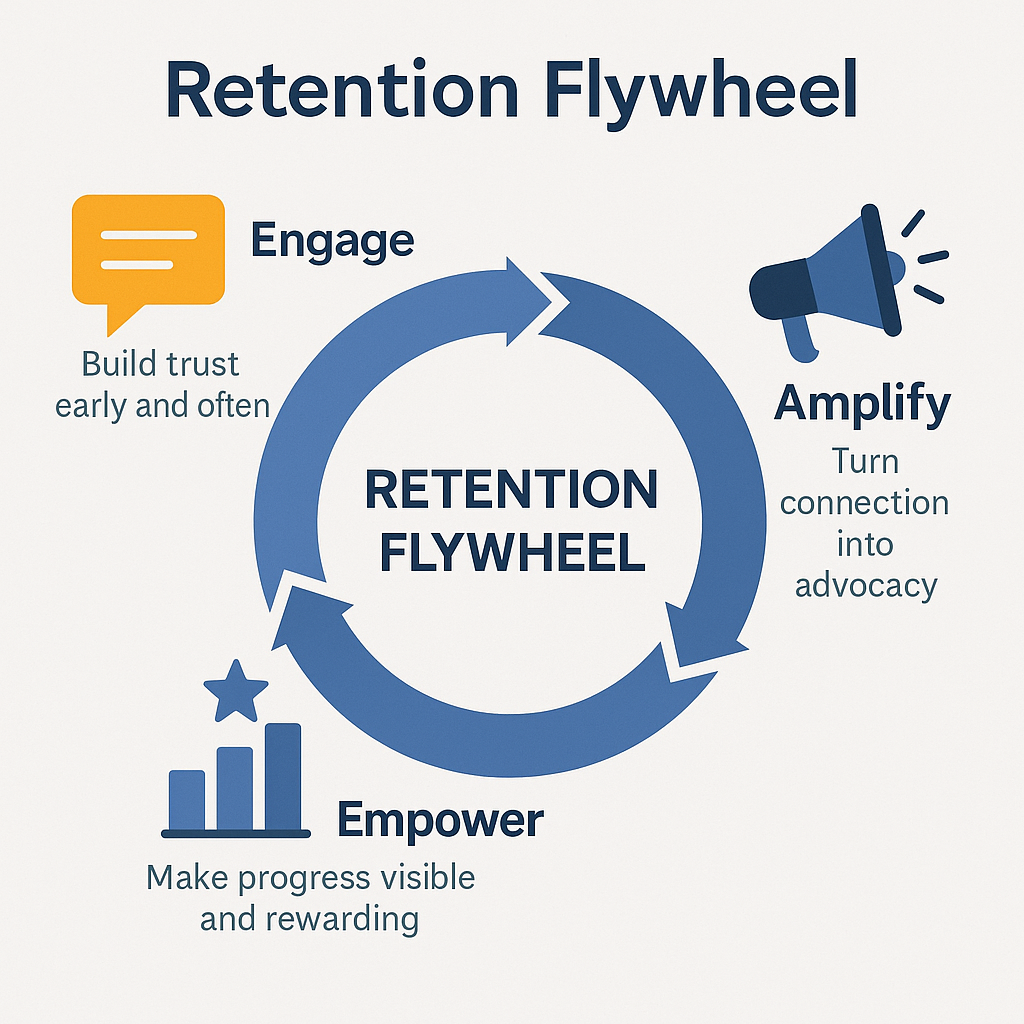
What’s a Retention Flywheel?
A Retention Flywheel is a growth system where every patient interaction in person and between visits builds momentum.
Instead of restarting from zero each month, your existing patients drive new growth through stronger engagement, better outcomes, and word-of-mouth referrals.
This is how modern chiropractic practices scale sustainably, not by chasing more new leads, but by deepening relationships with the ones they already serve.
In short:Connection compounds. Every message, milestone, and moment adds power to your practice.
The Three Stages of a Patient Retention Flywheel
Engage: Build trust early and often
Engagement starts before the first adjustment. From that first text reminder to the post-visit message, every small, human touch builds trust.
Use SMS or email for logistics (reminders, reschedules, reactivations).
Use in-app messaging (via EMBODI) for clinical check-ins, secure, compliant, and personal.
This dual-lane communication keeps your team efficient and your patients feeling seen.
Goal: Make patients feel seen, supported, and accountable, from day one.
Empower: Make progress visible and rewarding
Patients don’t stay because you tell them to — they stay because they can see progress.
That’s why gamification, visual tracking, and micro-wins matter. They transform “Am I getting better?” into “I am getting better.
With EMBODI, clinics automatically track engagement, celebrate milestones, and send data-driven encouragement, all without adding admin work.
Goal: Make patients feel seen, supported, and accountable, from day one.
Amplify: Turn connection into advocacy
When patients feel cared for, they become advocates.
Each happy patient powers the next round of growth through referrals, reviews, and retention.
Practical steps:
Ask for a review right after a win or milestone
Share success stories with consent
Celebrate your patients (email, lobby screen, social)
Goal: Every happy patient becomes your best marketing channel.
🔁 Why the Retention Flywheel Works
A strong retention system is like compound interest for your practice.
The more you invest in connection, the faster it grows.
When each stage, engage, empower, amplify, feeds the next, you create self-sustaining growth instead of constant new-patient hustle.
And this is where technology matters.
Most “patient management” tools stop at reminders.
EMBODI goes further; it keeps the relationship moving between visits.
It’s one secure platform that helps you: ✅ Automate engagement (no manual follow-ups) ✅ Track patient progress and motivation ✅ Build lasting relationships that drive retention and referrals
Across independent clinics using EMBODI:
36% more visits kept
40% more consistent revenue
Same care. Different connection.
Why EMBODI Stands Out
Where other tools focus on admin efficiency, EMBODI focuses on engagement, the part that actually drives retention.
It bridges both lanes of communication:
Clinical check-ins (in-app) HIPAA-compliant, trackable, and personalized.
Logistics (SMS/email) fast, friendly, and simple to automate.
It’s not another system to manage; it’s the engine that keeps your Retention Flywheel spinning.
🚀 Ready to Build Your Flywheel?
Start small, one touchpoint per stage:
ENGAGE → Add a friendly “day-before” reminder.
EMPOWER → Send a progress check-in after week two.
AMPLIFY → Ask for feedback after each treatment milestone.