The Complete Guide to RTM Billing for Chiropractors (2026)

The Complete Guide to RTM Billing for Chiropractors (2026) | EMBODI

How to capture ~$85+ per patient/month in recurring revenue for work you're already doing

1. What is RTM (Remote Therapeutic Monitoring)?

Remote Therapeutic Monitoring (RTM) is a set of CPT codes that allow healthcare providers to bill for non-physiologic patient monitoring and treatment management services delivered remotely.

In plain English: You can bill for the time you spend managing patients between office visits.

If you're:

  • Texting patients about their home exercise compliance
  • Reviewing their progress data remotely
  • Adjusting care plans based on their feedback
  • Monitoring adherence through apps or systems
  • Responding to patient questions about their treatment

You're doing RTM work. The question is: are you billing for it?

RTM vs. RPM: What's the Difference?

RPM (Remote Physiologic Monitoring) tracks physiologic data like blood pressure, glucose, weight, heart rate.

RTM (Remote Therapeutic Monitoring) tracks non-physiologic data like:

  • Exercise completion and adherence
  • Musculoskeletal symptoms
  • Range of motion progress
  • Pain levels
  • Functional improvement
  • Therapy compliance

For chiropractors, RTM is the relevant code set because you're monitoring therapeutic activities (home exercises, stretches, rehab protocols), not vital signs.

2. Why RTM is Perfect for Chiropractic Care

Chiropractic care extends well beyond the adjustment table. Effective treatment requires:

  • Patient education on home exercises
  • Ongoing compliance monitoring
  • Progress tracking between visits
  • Care plan adjustments based on patient feedback
  • Communication about setbacks or improvements

You're already doing this work. RTM simply allows you to get paid for it.

The Revenue Opportunity

$51K-57K
Annual RTM revenue for 100-patient practice (2026 rates)

Conservative estimate for a practice with 100 active patients:

  • 40-50% qualify for RTM (patients with ongoing therapeutic programs)
  • Average reimbursement: ~$85-95 per patient/month (2026 actual rates)
  • Monthly RTM revenue: $4,250 - $4,750
  • Annual RTM revenue: $51,000 - $57,000

For work you're already doing.

But RTM Doesn't Exist in Isolation

RTM is ONE of THREE revenue streams every patient creates. Most chiropractors only capture one.

When combined with:

  • RETENTION: Gamified HEPs that patients actually complete (+2.5 visits/patient)
  • REWARDS: Systematic referrals and cash service purchases

The total revenue impact is 3-4x higher.

That's the Flywheel.

3. The Three RTM CPT Codes Explained (2026 Actual Rates)

RTM billing uses three CPT codes. Here's what each one covers with 2026 actual reimbursement rates:

CPT 98975

Initial Setup & Patient Education

What it is: Initial setup and patient education on using the monitoring system (20 minutes minimum).

When to bill: Once per patient when you educate them on how to use the system, what to track, and how to report progress.

2026 Rate: $21.71
Example

You spend 20 minutes showing the patient how to record their exercises, track symptoms, and message you through the app. Bill 98975.

CPT 98977 ↑ 29% Higher Than Expected

Device Supply & Monitoring (16-30 days)

What it is: Supply of therapeutic monitoring device or application with data transmission (16-30 days).

When to bill: Monthly for each patient actively using the monitoring system.

2026 Rate: $51.44

Key Update: This code jumped to $51.44 in 2026 (expected $39.75) — 29% higher than projected! This makes RTM significantly more profitable than previous estimates.

CPT 98980

Treatment Management Services (20+ minutes)

What it is: Monthly treatment management, including monitoring patient data and adjusting the care plan (20 minutes minimum per calendar month).

When to bill: Every month for each patient who meets the time threshold.

2026 Rate: $54.11
Example

Throughout the month, you:

  • Review patient exercise completion data (5 minutes)
  • Respond to patient messages about pain levels (4 minutes)
  • Adjust their HEP based on progress (3 minutes)
  • Check adherence reports and follow up (4 minutes)
  • Document everything (4 minutes)
  • Total: 20 minutes → Bill 98980

Updated Revenue Per Patient (2026 Rates)

Annual Revenue Breakdown

Patient on RTM for full year:

  • Setup (98975): $21.71 one-time
  • Device supply (98977): $51.44/month × 12 = $617.28
  • RTM service (98980): $54.11/month × 12 = $649.32
  • Total per patient/year: $1,288

For 50 patients: $64,400/year in RTM revenue

4. Who Qualifies for RTM Billing

Not every patient qualifies for RTM. Here are the criteria:

Qualifying Conditions

Patients must have a musculoskeletal condition requiring therapeutic monitoring, such as:

  • Chronic low back pain
  • Neck pain and cervical dysfunction
  • Post-injury rehabilitation
  • Posture correction programs
  • Chronic joint conditions
  • Neurological rehabilitation
  • Sports injury recovery
  • Any condition requiring ongoing therapeutic exercise

Qualifying Activities

The patient must be engaged in therapeutic activities you're monitoring:

  • Home exercise programs (HEPs)
  • Stretching protocols
  • Postural correction exercises
  • Functional movement training
  • Pain management techniques
  • Rehabilitation protocols

Patient Consent

Patients must:

  • Consent to RTM monitoring
  • Agree to use the monitoring system/app
  • Understand the service is billable

Get written consent before starting RTM billing.

5. The 16-Minute Threshold (What Actually Counts)

Here's where most chiropractors get confused.

To bill CPT 98980 each month, you must spend at least 20 minutes of interactive time managing that patient remotely.

What Counts Toward the 20 Minutes

✅ Activities that count:

  • Reviewing patient-reported exercise completion data
  • Analyzing progress reports and adherence metrics
  • Responding to patient messages about symptoms or concerns
  • Adjusting care plans based on remote feedback
  • Reviewing video submissions of exercises
  • Educating patients on technique modifications
  • Following up on missed exercises or setbacks
  • Documenting all of the above

❌ Activities that DON'T count:

  • Time spent during in-office visits (that's billed separately)
  • Automated system notifications (no human interaction)
  • Scheduling appointments
  • Billing and administrative tasks
  • General practice management

Real-World Examples

Example 1: Patient texts about increased pain
  • Read message and review recent exercise data: 3 minutes
  • Respond with care plan adjustment: 2 minutes
  • Document interaction: 1 minute
  • Total: 6 minutes
Example 2: Weekly progress review
  • Check adherence dashboard for 5 patients: 8 minutes
  • Message 2 patients who are behind: 4 minutes
  • Document reviews: 3 minutes
  • Total: 15 minutes across multiple patients
Example 3: Patient video review
  • Watch patient's exercise video submission: 2 minutes
  • Identify form issues: 1 minute
  • Send corrective feedback: 3 minutes
  • Document: 1 minute
  • Total: 7 minutes

Tracking Time Efficiently: The challenge is tracking these micro-interactions across dozens of patients. Most chiropractors spend well over 20 minutes per patient per month on remote monitoring — they're just not documenting it.

6. Documentation Requirements

Proper RTM billing requires documentation that proves:

  1. The service was medically necessary
  2. You spent the required time
  3. The patient received therapeutic benefit

Sample Documentation Entry

Good Documentation Example

Date: May 15, 2026
Patient: John Smith
Activity: Reviewed HEP adherence report
Time: 4 minutes
Findings: Patient completed 5/7 prescribed exercises. Reported increased lower back pain during bridges.
Action: Modified bridge exercise to reduced range. Sent video demonstration and follow-up message.
Total RTM time this month: 22 minutes

Common Documentation Mistakes

❌ Vague entries: "Checked in with patient"
✅ Specific entries: "Reviewed 7-day exercise log, noted 40% adherence, messaged patient about barriers"

❌ No time tracking: "Managed care remotely"
✅ Time documented: "5 minutes reviewing data, 3 minutes responding to message"

7. Reimbursement Rates & Payer Coverage

Medicare Coverage (2026 Actual Rates)

Good news: Medicare covers RTM codes for qualified patients.

Reimbursement rates (2026 National Average):

  • CPT 98975: $21.71
  • CPT 98977: $51.44 (29% higher than expected!)
  • CPT 98980: $54.11

Commercial Payers

Most major commercial insurers cover RTM, but policies vary:

Generally covered:

  • Blue Cross Blue Shield (most plans)
  • Aetna
  • Cigna
  • UnitedHealthcare
  • Humana

Recommendation: Before implementing RTM billing, verify coverage with your top 5 payers. Most practices find 60-80% of patients have RTM-covered plans.

Calculate Your RTM Revenue Opportunity

Want to see your specific RTM potential? Our calculator uses 2026 actual rates and your payer mix to project your revenue. Takes 2 minutes, no email required.

8. Why Manual RTM Doesn't Scale

Here's the brutal truth about manual RTM implementation:

The math doesn't work.

The Manual RTM Workflow

To bill RTM manually, you need to:

  1. Track every patient interaction (text, call, data review)
  2. Log time spent on each activity
  3. Calculate monthly totals per patient
  4. Generate billing-compliant documentation
  5. Submit claims with proper codes
  6. Monitor for threshold compliance

Time required per patient per month: 20-30 minutes of administrative work.

Revenue per patient: ~$85-95

Your effective hourly rate for RTM admin: ~$100-140/hour

That's less than your clinical rate. You're essentially trading clinical time for billing admin.

The Scale Problem

Let's say you want to bill RTM for 50 patients:

Manual approach:

  • 20 minutes admin per patient
  • 50 patients × 20 minutes = 1,000 minutes
  • That's 16.6 hours per month on RTM documentation alone

Without Automation, You Can't Capture All 3 Revenue Streams

If RTM documentation alone takes 16+ hours/month, how can you also:

  • Monitor patient engagement for retention
  • Track reward redemptions and referrals
  • Manage gamified HEP compliance
  • Analyze which patients need outreach

You can't. That's why most practices only capture one revenue stream (visits) and leave the other two on the table.

9. The Automation Solution

The only way RTM scales is through automation.

What Should Be Automated

Time Tracking:

  • Every patient message automatically logged with timestamp
  • Data reviews tracked when you open patient reports
  • Time calculated automatically
  • Monthly totals flagged when threshold is hit

Documentation:

  • Interactions auto-logged with date/time/activity
  • Clinical notes from your review tied to RTM entries
  • Billing reports generated automatically
  • Compliance-ready export for claims

ROI Comparison

50x
Better hourly value with automation

Manual RTM (50 patients):

  • Revenue: $4,250-4,750/month
  • Admin time: 16+ hours/month
  • Net hourly value: ~$100/hour

Automated RTM (50 patients):

  • Revenue: $4,250-4,750/month
  • Admin time: 30 minutes/month
  • Net hourly value: ~$5,000-6,000/hour

Automation pays for itself in week 1.

The EMBODI Approach: Automate All Three Streams

EMBODI doesn't just automate RTM — it automates the entire revenue flywheel:

  • REWARDS: Gamification engine tracks points, streaks, milestones automatically
  • RETENTION: AI-personalized HEPs keep patients engaged and completing care plans
  • RTM: Every interaction auto-logged, time tracked, billing reports generated

Result: You capture all 3 revenue streams from 50+ patients with 30 minutes of admin per month.

10. Implementation Roadmap

Ready to implement RTM in your practice? Here's the step-by-step process:

Phase 1: Preparation (Week 1-2)

  • Verify payer coverage with your top 5 insurers
  • Choose your technology platform
  • Update patient consent forms
  • Train your team on RTM workflows

Phase 2: Pilot Program (Week 3-6)

Start with 10-15 patients who:

  • Have chronic conditions requiring ongoing HEP
  • Are tech-comfortable (if using an app)
  • Have good insurance coverage
  • Visit regularly

Phase 3: Scale (Month 2-3)

Expand to 30-50 patients:

  • Onboard 10-15 new patients per week
  • Refine your workflow based on pilot learnings
  • Automate wherever possible
  • Monitor revenue vs. time investment

Ready to See Your Numbers?

Use our RTM ROI Calculator to project your revenue with 2026 actual rates. Factor in your patient volume, payer mix, and practice size. Get your personalized report in 2 minutes.

11. Common Mistakes to Avoid

Mistake #1: Billing Without Proper Documentation

The error: Assuming you spent enough time without tracking it.

The fix: Document every interaction with date, time, and activity. If you didn't document it, you can't bill it.

Mistake #2: Counting In-Office Time

The error: Including time spent during office visits in your RTM calculation.

The fix: Only count remote interactions. In-office time is billed via E&M or procedure codes.

Mistake #3: No Patient Consent

The error: Starting RTM monitoring without informing patients it's billable.

The fix: Get written consent explaining the service and that it will be billed to insurance.

Mistake #4: Trying to Scale Manually

The error: Attempting to bill RTM for 30+ patients using spreadsheets and manual time logs.

The fix: Invest in automation from day 1. The ROI is immediate and the alternative doesn't scale.

12. Frequently Asked Questions

Q: Can I bill RTM and E&M codes for the same patient on the same day?

A: Yes, but they must be separate services. RTM is for remote monitoring between visits. E&M is for in-office evaluation. Time spent during the office visit does NOT count toward RTM time.

Q: What if I spend 10 minutes in one month and 30 minutes the next?

A: You can't "roll over" time. Each calendar month stands alone. If you don't hit 20 minutes in a given month, you can't bill 98980 that month.

Q: Do I need special technology to bill RTM?

A: No. You can theoretically bill RTM with just text messages and manual time tracking. However, automation makes RTM practical at scale. Without it, most practices can't justify the administrative burden.

Q: How long does it take for RTM claims to be paid?

A: Typical insurance processing time: 15-45 days. Medicare is usually faster (14-30 days). If your documentation is solid, acceptance rates should be high (>90%).

Q: Are the 2026 rates permanent?

A: CMS updates rates annually. The $51.44 rate for 98977 is the 2026 national average. Geographic adjustments may vary slightly by region, but this is the baseline.

See RTM Automation in Action

EMBODI automates RTM tracking, documentation, and billing across all 3 revenue streams. Capture $51K-57K in annual RTM revenue with 30 seconds of admin per patient per month.

About the Author

Dr. Jay Greenstein is the Founder & CEO of EMBODI and a 2026 nominee for UAC's Top 20 Most Influential People in Chiropractic. After running multiple chiropractic practices and implementing RTM billing systems, he created EMBODI to make remote patient monitoring practical and profitable for chiropractors.

Vote for Dr. Jay: UAC Top 20 Most Influential →

How to Build a Patient Retention Flywheel for Your Chiropractic Practice

The framework chiropractors use to grow through connection. NOT constant lead generation.

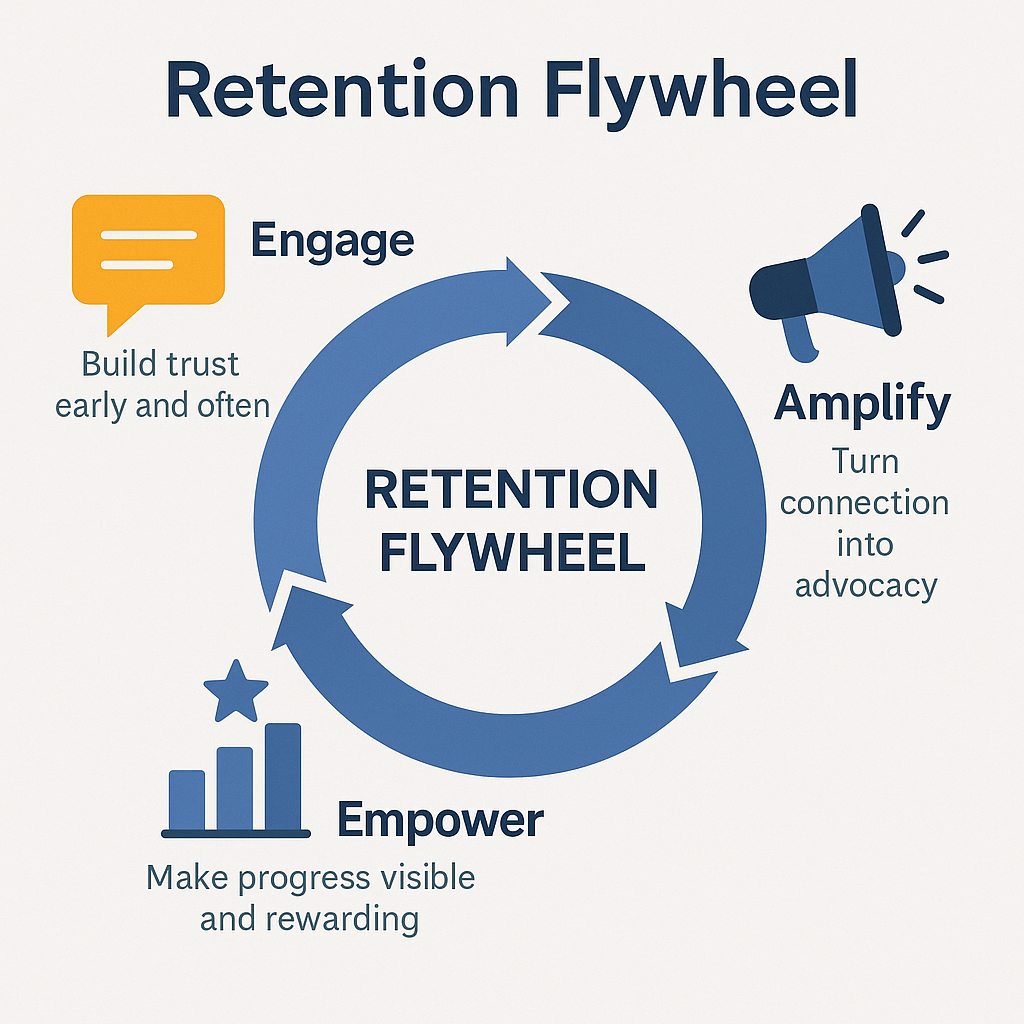
What’s a Retention Flywheel?

A Retention Flywheel is a growth system where every patient interaction in person and between visits builds momentum.

Instead of restarting from zero each month, your existing patients drive new growth through stronger engagement, better outcomes, and word-of-mouth referrals.

This is how modern chiropractic practices scale sustainably, not by chasing more new leads, but by deepening relationships with the ones they already serve.

In short: Connection compounds. Every message, milestone, and moment adds power to your practice.

The Three Stages of a Patient Retention Flywheel

Engage: Build trust early and often

Engagement starts before the first adjustment. From that first text reminder to the post-visit message, every small, human touch builds trust.

  • Use SMS or email for logistics (reminders, reschedules, reactivations).

  • Use in-app messaging (via EMBODI) for clinical check-ins, secure, compliant, and personal.

This dual-lane communication keeps your team efficient and your patients feeling seen.

Goal: Make patients feel seen, supported, and accountable, from day one.

Empower: Make progress visible and rewarding

Patients don’t stay because you tell them to — they stay because they can see progress.

That’s why gamification, visual tracking, and micro-wins matter.
They transform “Am I getting better?” into “I am getting better.

With EMBODI, clinics automatically track engagement, celebrate milestones, and send data-driven encouragement, all without adding admin work.

Goal: Make patients feel seen, supported, and accountable, from day one.

Amplify: Turn connection into advocacy

When patients feel cared for, they become advocates.

Each happy patient powers the next round of growth through referrals, reviews, and retention.

Practical steps:

  • Ask for a review right after a win or milestone

  • Share success stories with consent

  • Celebrate your patients (email, lobby screen, social)

Goal: Every happy patient becomes your best marketing channel.

🔁 Why the Retention Flywheel Works

A strong retention system is like compound interest for your practice.

The more you invest in connection, the faster it grows.

When each stage, engage, empower, amplify, feeds the next, you create self-sustaining growth instead of constant new-patient hustle.

And this is where technology matters.

Most “patient management” tools stop at reminders.

EMBODI goes further; it keeps the relationship moving between visits.

It’s one secure platform that helps you:
✅ Automate engagement (no manual follow-ups)
✅ Track patient progress and motivation
✅ Build lasting relationships that drive retention and referrals

Across independent clinics using EMBODI:

  • 36% more visits kept

  • 40% more consistent revenue

Same care. Different connection.

Why EMBODI Stands Out

Where other tools focus on admin efficiency, EMBODI focuses on engagement, the part that actually drives retention.

It bridges both lanes of communication:

  • Clinical check-ins (in-app) HIPAA-compliant, trackable, and personalized.

  • Logistics (SMS/email) fast, friendly, and simple to automate.

It’s not another system to manage; it’s the engine that keeps your Retention Flywheel spinning.

🚀 Ready to Build Your Flywheel?

Start small, one touchpoint per stage:

  • ENGAGE → Add a friendly “day-before” reminder.

  • EMPOWER → Send a progress check-in after week two.

  • AMPLIFY → Ask for feedback after each treatment milestone.

Then watch momentum build, automatically!

Want to see it in a live clinic?


Book a zero-commitment Discovery Demo.

See how EMBODI helps chiropractic teams turn everyday patients into raving fans.
Because retention isn’t luck — it’s built.

(Blog comments open below—share your toughest retention leak and we’ll reply with a tactical fix.)

The Patient-Communication System That Quietly Lifts Retention

Why Patient Communication Is the Growth Engine of Your Practice

And why EMBODIconnect is the only system designed for retention, engagement, and compliance

The Silent Profit Leak You’re Overlooking

Most practices don’t lose patients because of poor care. They lose them because of poor communication.

Here’s the reality:

  • Phone tag frustrates patients and burns staff time.

  • Late follow-ups miss the critical “post-visit 1–3” window when most drop-offs happen.

  • Vague reminders don’t drive adherence—or retention.

The result? A silent leak of patients and revenue.

That’s why we built EMBODIconnect: not another SMS tool, but a retention and engagement engine that closes the communication gap, keeps patients on track, and fills schedules without burning out staff.

Clinic testimonial


“When we switched to EMBODIconnect, everything improved. Patients started responding quickly and showing up consistently. Automations handle reminders and reactivations—hands-off. Even nights and weekends became productive because new patients book online at all hours. It’s transformed how we operate—I wouldn’t run our clinics without it.”


— Cat, Director of Operations (Kaizo Health Clinics)

What Is EMBODIconnect?

EMBODIconnect is a two-way patient communication engine—text, email, automation, and HIPAA-compliant in-app messaging—built inside EMBODI for MSK practices.

It reduces no-shows, improves adherence, and even captures after-hours bookings, all while keeping communication clinical when it needs to be, and convenient when it doesn’t.

Why This Matters (And Where Clinics Leak)

A great care plan fails when communication fails. Patients don’t ghost because they don’t care—they ghost because they don’t feel connected.

Typical leaks:

  • After visit 1–3, when soreness or fear sets in.

  • When pain improves and they think they’re “done.”

  • When staff can’t follow up consistently.

The fix: A system that provides:

  • Right message, right time.

  • HIPAA compliance for clinical check-ins.

  • Convenience for everything else.

How EMBODIconnect Works (Inside EMBODI)

HIPAA-Compliant Clinical Messaging (EMBODI Core)

Most platforms stop at SMS reminders. EMBODI goes further with secure, in-app messaging that keeps providers HIPAA compliant. You can run real clinical check-ins, review symptom updates, adjust plans, and even upload/share documents—without ever exposing your practice to risk.

Two-Way SMS + Email (EMBODIconnect)

For everything outside clinical messaging, EMBODIconnect powers two-way SMS and email. Reminders, reschedules, reactivations—all in one tap. It’s the convenience patients expect, without overloading your staff.

Automated Reminders

Standard workflows like visit reminders, day-after follow-ups, and 30/60/90-day reactivation pings—running automatically in the background.

Smart Clinical Triggers

Dynamic automations that respond to patient-reported outcomes. For example: if a patient reports soreness after an exercise, EMBODI can trigger a supportive check-in, flag the care team, or adjust the home exercise plan—closing the loop before issues become cancellations.

After-Hours Lead Capture

Custom forms plus auto-scheduling let new patients book themselves at night or on weekends. Your schedule fills while your staff rests.

Dashboards That Matter

One view, built for clinics: opens, replies, reschedules, kept visits, and adherence rates. Real-time data you can act on to improve both patient experience and clinic revenue.

Templates You Can Use Today (paste into EMBODIconnect)

Appointment reminder (Show-Up Saver)

Hi [Name] — you’re on for [Day] at [Time].
Reply Y to confirm or RESCHEDULE for a better time.

Day-1 Check-In (catch problems early)

How did [exercise] feel today?
1 = Great, 2 = Tight, 3 = Need help.
(If “3,” we’ll adjust your plan.)

No-show rescue

We missed you today and want you to feel better fast.
Tap to grab the next spot: [link]. Need help? Just reply.

Milestone celebration

🎉 5-day streak, [Name]! Small wins stack.
Next step: add 1 set to [exercise]. You’ve got this.

Reactivation (30/60/90 days)

Quick check-in on your [condition].
Want a tune-up? Reply YES and we’ll text you times.

Reviews & referrals

Glad you’re feeling better, [Name].
Would you share a quick Google review? It helps neighbors find care: [link]

Implementation checklist

  • Two-way SMS verified (local area code)

  • Contact list synced and tagged.

  • 3 core workflows active (reminders, day-after, reactivation)

  • After-hours form connected to the calendar

  • Dashboard tile pinned: kept-visit rate week-over-week 

What Success Looks Like (qualitative signals you’ll notice)

  • Fewer “Sorry I missed your call” loops

  • Faster replies to simple questions

  • Smoother rescheduling without staff back-and-forth

  • Patients referencing texts in the room (“I loved the quick video you sent”)

  • A calmer front desk and a steadier schedule

The Takeaway

Most tools promise reminders. EMBODIconnect delivers retention and engagement:

  • HIPAA-compliant clinical messaging (others can’t do this safely).

  • SMS/email convenience for patients (no friction).

  • Automation that runs in the background.

  • Dashboards that tie it all back to revenue and retention.

It’s the only communication engine built specifically for MSK practices that protects providers, keeps patients engaged, and eliminates the silent profit leak.


Want to see it in a live clinic?


Book a zero-commitment Discovery Demo.

We’ll walk through our exact EMBODIconnect workflows, timing, and message library—and answer any ops questions.

(Blog comments open below—share your toughest retention leak and we’ll reply with a tactical fix.)

FAQ


Q: Why does texting beat calling for appointments?
A: Texts are fast, low-friction, and asynchronous; one-tap replies reduce missed calls and phone tag.

Q: Will automations feel impersonal?
A: Not if you personalize variables ([Name], [Exercise], [Next Appointment]) and keep messages brief, helpful, and timely.

Q: Can this support RTM?
A: Yes. EMBODIconnect can prompt symptom check-ins, capture quick scales, and route flags to the care team, supporting RTM documentation and timely plan adjustments.

Q: How soon should I send the first post-visit message?
A: 24–36 hours after visit 1 is the sweet spot for catching soreness, confusion, or scheduling friction before it becomes a cancellation.

RTM Uncovered: The Secret Weapon for Chiropractors to Boost Retention and Revenue

Here is Your Wake-Up Call

Ever looked at your appointment book and wondered why patients vanish after just a handful of visits? You’re giving the best adjustments, your front desk team’s friendly, your equipment’s cutting-edge—and yet, patients still drop off.

We’ve been there. But then we made a critical shift: we introduced Remote Therapeutic Monitoring (RTM), and suddenly, our patients started sticking around. Better retention, better results, better revenue—without piling on extra hours.

Here’s exactly how we did it.

📌 What Exactly is Remote Therapeutic Monitoring (RTM)?

In simple terms, RTM is your new best friend for keeping your patients engaged, accountable, and on-track outside your clinic.

Instead of sending patients home with paper exercises that (let’s be honest) often end up forgotten, RTM digitally monitors their therapeutic activities, progress, pain levels, and adherence in real-time.

By connecting with patients through an intuitive app, chiropractors can continuously track patient progress, proactively adjust care plans, and create an environment of accountability that’s proven to boost results.

📌 The Big “Why”: Clinical Benefits of RTM

RTM isn’t just tech for tech’s sake. It’s a clinical game changer.

  • Higher Adherence, Less Guesswork: RTM’s automated reminders and real-time feedback ensure patients stick to their care plans, drastically reducing missed exercises and therapy sessions.

  • Immediate Intervention: With instant data updates, you can catch setbacks before they become major issues. Immediate feedback means faster healing, fewer complications, and happier patients.

  • Personalized Adjustments: Gone are the days of standardized care. RTM allows you to fine-tune each patient’s therapeutic plan based on live data—making every patient feel like they’re your only patient.

According to peer-reviewed research published in the Journal of Medical Internet Research, clinics implementing RTM see patient adherence jump by up to 70%, driving significantly better clinical outcomes.

📌 How RTM Fuels Patient Retention (and Why That Matters)

Patient retention is the lifeblood of your practice. The math is simple: keeping existing patients engaged is dramatically more cost-effective than constantly acquiring new ones.

By adding RTM, practices consistently see:

  • Higher visit adherence rates (up to 40% improvement)

  • Increased patient satisfaction and perceived value of care

  • More consistent patient follow-through on care recommendations

Bottom line? More visits, happier patients, and healthier practice revenues.

📌 Turn Your Care into Cash: New Revenue Streams with RTM

Let’s be clear: RTM is not charity work—it’s a smart, strategic revenue driver.

RTM integrates smoothly with your billing, creating clear and sustainable income opportunities:

  • Monthly Monitoring Fees (CPT codes 98976/98977): Bill regularly for ongoing remote care and data tracking.

  • Treatment Management (CPT codes 98980/98981): Generate revenue from active management of patient adherence, communications, and care-plan adjustments.

  • Subscription-Based Wellness Plans: Offer premium care packages, bundling RTM with your HEPs and coaching services for consistent monthly income.

📌 Getting Started: 5 Steps to Implementing RTM in Your Clinic

Ready to embrace RTM but unsure how to begin? Here’s your practical, actionable guide:

Step 1: Pick the Right Platform
Start with a user-friendly, reliable app (like EMBODI) designed specifically for chiropractic and physical therapy practices.

Step 2: Introduce RTM to Your Patients Early
Mention RTM during the very first consultation. Demonstrate how it keeps them accountable and connected, enhancing their healing journey.

Step 3: Automate Your Patient Engagement
Use RTM to set up automated check-ins, personalized reminders, and friendly motivation boosts. The goal: fewer manual calls, more automated nurturing.

Step 4: Track, Assess, Adjust
Regularly monitor patient data and make quick care-plan adjustments. A few clicks can prevent patient dropout and keep outcomes on track.

Step 5: Bill Consistently and Confidently
Leverage your new RTM-generated data to ensure your billing reflects the quality and consistency of your care. You’re not just tracking activities—you’re proving your value.

📌 The RTM Edge: Why Smart Chiropractors are Already Onboard

Early adopters of RTM aren’t just tech enthusiasts—they’re strategic thinkers. They understand that patient retention, satisfaction, and practice growth don’t happen by chance. They’re outcomes driven by consistent, high-quality engagement and care.

EMBODI clinics using RTM and gamification see measurable improvement:

  • 70% higher patient adherence rates

  • Increased patient engagement and referrals

  • Substantial revenue boosts through billable services

This isn’t a tech trend—it’s a proven strategy.

🚀 Ready to Make RTM Your New Revenue Engine?

There’s no reason your practice should miss out on this advantage. If you’re ready to shift from guesswork to guaranteed results, let’s talk.

Book a zero-commitment Discovery Demo today and we’ll show you exactly how RTM integrates seamlessly into your practice workflow.

👉 [Book Your Discovery Demo]

Introducing EMBODIconnect: Revolutionizing Patient engagement

The wait is over! Today, we proudly reveal our most innovative engagement tool:  EMBODIconnect.

Imagine a practice where you never have to worry about losing touch with your patients. Many practitioners face challenges in keeping patients engaged and ensuring they follow through with their health plans. This disconnect can lead to lower patient satisfaction and retention.

EMBODIconnect is our revolutionary new feature designed to reengage your patients seamlessly. You can now automate your messaging, send appointment reminders, and even get paid for messaging your patients.

It’s the ultimate tool to keep your practice running smoothly while maintaining strong patient relationships.

 EMBODIconnect helps you retain patients by keeping them actively involved in their health journey.

This new feature makes it easy for patients to stay connected and refer your practice to others, enhancing your practice’s growth and reputation.

Don’t miss out on exploring all its features and benefits.
Get on a discovery call with us today, and we’ll walk you through how EMBODIconnect, on top of the EMBODI platform, can revolutionize your practice.

Stay tuned for more updates and detailed insights into how EMBODIconnect can elevate your practice to new heights.

We have more to share with you, so keep your eyes open for our upcoming blogs.

We will reveal more about how this new feature can revolutionize your practice, keep your patients engaged, and retain your patients.

Stay Tuned… The Revolution is Just Beginning…